
Strengthen the means of implementation and revitalize the Global Partnership for Sustainable Development
SDG 17 Indicator
17.4 – Education for the SDGs
17.4.1 – Education for SDGs commitment to meaningful education
Universiti Kebangsaan Malaysia (UKM) demonstrates a strong commitment to meaningful education for the Sustainable Development Goals (SDGs) by embedding sustainability principles into its curriculum and expanding opportunities for sustainability learning. This commitment aims to equip students with the knowledge, values and skills to address sustainability challenges within their disciplines and communities.
The UKM Sustainability Policy 2030, under its commitment to SDG 4: Quality Education, explicitly commits the university to integrating sustainability principles into the curriculum, offering specialised courses and workshops on the SDGs, and providing educational programmes in SDG-related fields for everyone, including individuals beyond the UKM community.
This commitment is further reinforced by the UKM Sustainability Strategic Plan 2030, under Sustainability Pillar 2: Teaching and Learning, Objective 2: Cultivating Sustainability through Education (page 21). The plan sets an explicit target to require all undergraduate students to take at least one subject related to sustainability, the environment and climate change. It also outlines initiatives to expand relevant courses and programmes, strengthen environmental and climate awareness, and collaborate with government agencies, industry, and communities. Together, these provisions establish a university-wide commitment to ensuring that sustainability education reaches students across disciplines and connects academic learning with societal challenges.
1. UKM Sustainability Policy 2030
UKM has a commitment to meaningful education around the SDGs across the university, relevant and applicable to all students. As a leading university with a global mission and vision, UKM is ready to shoulder the responsibility towards creating a more sustainable future. The UKM Sustainability Policy 2030 was approved by the University Management Meeting (MPU) No. 5/2024 dated April 3, 2024. UKM embraces the Sustainable Development Goals (SDGs) agenda formulated by the United Nations (UN) as a universal roadmap for the advancement of the university and all its citizens, which comprises staff and students, and is committed to integrating SDG principles into every activity and core process of university life.

The image contains UKM’s Sustainability Policy 2030, outlining its commitment to aligning with the 17 Sustainable Development Goals (SDGs). Here’s a breakdown of each SDG as per UKM’s policy:
- No Poverty: Ensures access to essential resources and support for all citizens, regardless of race, religion, or gender.
- Zero Hunger: Implements programs to reduce hunger and promote sustainable agriculture, healthy diets, and food security for citizens.
- Good Health and Well-being: Prioritizes mental and physical well-being through accessible health services, promoting healthy lifestyles, and public health awareness.
- Quality Education: Integrates sustainability into the curriculum and provides SDG-focused education and workshops open to non-UKM citizens.
- Gender Equality: Promotes equality by supporting policies that empower women through education and community programs.
- Clean Water and Sanitation: Enhances water conservation, wastewater treatment, and research on water resources.
- Affordable and Clean Energy: Aims for 100% renewable energy by 2050, focusing on energy efficiency and renewable technologies.
- Decent Work and Economic Growth: Promotes employment opportunities, healthy work environments, and safety protocols.
- Industry, Innovation, and Infrastructure: Advances sustainable infrastructure, cutting-edge research, and partnerships with industry leaders.
- Reduced Inequalities: Embraces diversity, social justice, and collaboration to bridge societal gaps, empowering inclusive communities.
- Sustainable Cities and Communities: Uses campus as a model for sustainable urban planning, effective waste management, and green infrastructure.
- Responsible Consumption and Production: Focuses on sustainable procurement, energy efficiency, water conservation, and community education.
- Climate Action: Strives to achieve Zero Carbon Campus by 2050 through emissions reduction, adaptation strategies, and climate-resilient practices.
- Life Below Water: Protects marine biodiversity, raises awareness on sustainable conservation, and supports marine ecosystem research.
- Life on Land: Conserves natural ecosystems by restoring habitats, improving biodiversity, and promoting ecological research.
- Peace, Justice, and Strong Institutions: Advocates for human rights, security, justice, and equality within the university community.
- Partnerships for the Goals: Collaborates with partners to accelerate progress towards sustainability through shared knowledge and engagement in research.
Each SDG aligns with UKM’s vision of “Cultivating Sustainability for the Future,” emphasizing knowledge, quality, and virtue as core principles. This policy demonstrates UKM’s comprehensive approach to sustainability, integrating environmental, social, and governance priorities across university operations.
2. UKM Sustainability Strategic Plan 2030
UKM has a commitment to meaningful education around the SDGs across the university, relevant and applicable to all students. The UKM Sustainability Strategic Plan 2030, themed “Cultivating Sustainability for the Future,” outlines Universiti Kebangsaan Malaysia’s (UKM) comprehensive commitment to sustainable development, aligned with the United Nations Sustainable Development Goals (SDGs). This visionary plan builds on five fundamental pillars — Governance and Management, Teaching and Learning, Research and Innovation, Sustainable and Wellness Campus, and Community Engagement and Well-being — that collectively reinforce UKM’s role as a leader in sustainability for the region.
UKM enhances the quality of education as part of its Sustainability Strategic Plan 2030, UKM focuses on integrating sustainability into its curriculum and promoting health and well-being through educational initiatives. Besides, cultivating sustainability through education is our second objective for teaching and learning.
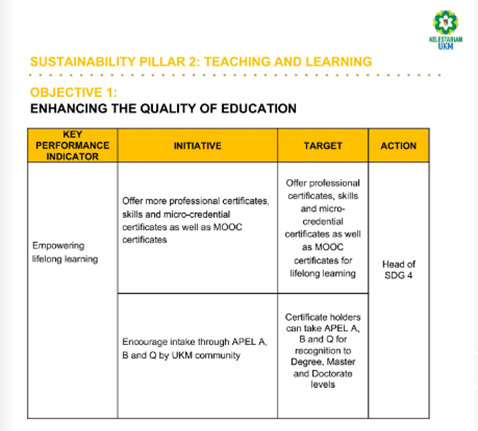
Under Objective 1, Enhancing the Quality of Education, UKM’s efforts to empower lifelong learning through the initiative of offering Professional and Micro-Credential Certificates: UKM plans to provide more professional certificates, skills training, micro-credentials, and MOOC (Massive Open Online Courses) certificates. This initiative aims to make education more accessible and flexible, enabling individuals to gain qualifications that suit their career needs. Under empowering lifelong learning, UKM also encourages the use of APEL A, B, and C within its community. APEL allows learners to gain formal recognition for their prior learning experiences, which can be converted into credits towards a degree, Master’s, or Doctorate program.
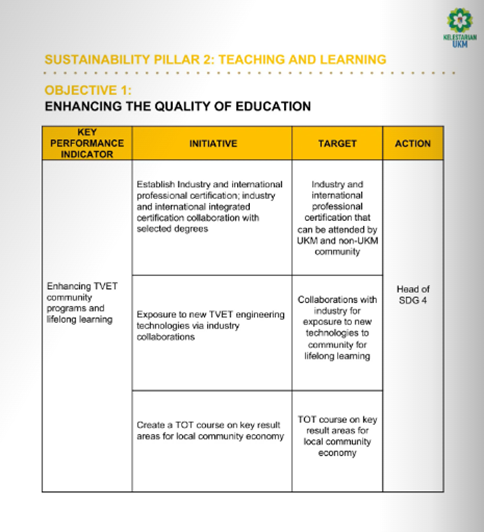
The second key indicator in this pillar specifically targets Enhancing TVET (Technical and Vocational Education and Training) community programs and lifelong learning. UKM plans to establish industry and international professional certifications through collaborations, integrating these certifications with selected degree programs. This approach aims to provide both UKM and non-UKM community members with recognized qualifications that enhance employability. Besides, through industry collaborations, UKM aims to expose the community to new engineering technologies, supporting continuous learning and skill upgrades within the TVET field. UKM intends to develop TOT courses focused on key areas that impact the local community economy. These courses will train trainers who can then pass on valuable skills and knowledge to others within the community.
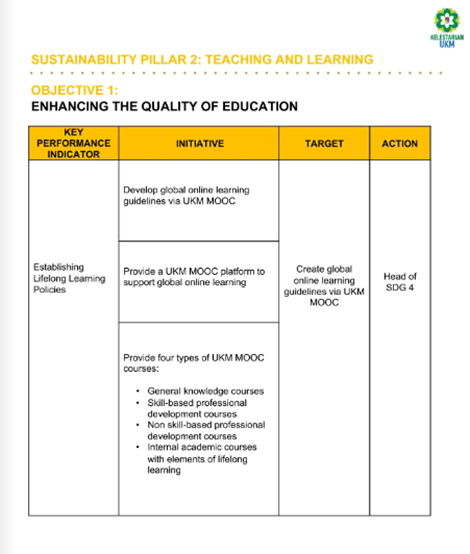
Enhancing the Quality of Education, specifically through Establishing Lifelong Learning Policies. The document highlights UKM’s commitment to fostering accessible, flexible, and continuous learning opportunities. UKM intends to establish guidelines for global online learning through its MOOC (Massive Open Online Course) platform, creating a structured and standardized approach to online education. The university plans to offer a dedicated MOOC platform to enable global access to online courses, making UKM’s educational resources available beyond the campus and across borders. Besides, UKM plans to provide various types of courses on its MOOC platform, including:
- General knowledge courses
- Skill-based professional development courses
- Non-skill-based professional development courses
- Internal academic courses incorporating lifelong learning elements
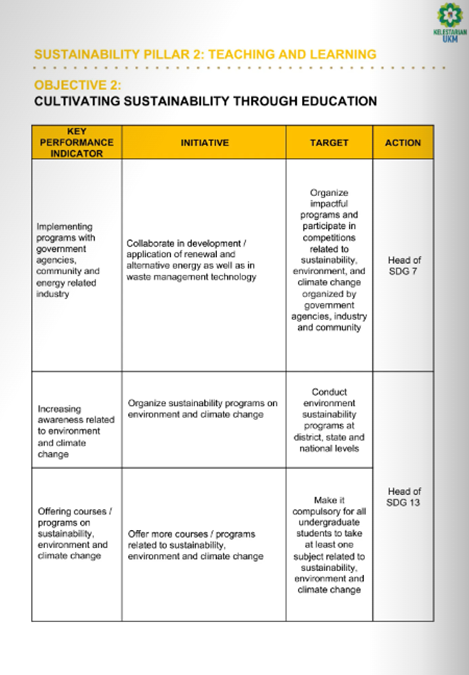
Sustainability Pillar 2: Teaching and Learning focuses on Objective 2: Cultivating Sustainability through Education. It emphasizes UKM’s efforts to promote sustainability awareness and education in collaboration with government agencies, industry, and the community. First key indicator is on Implementing Programs with Government Agencies, Community, and Industry: This KPI is aimed at fostering partnerships to develop renewable energy, alternative energy applications, and waste management technologies. Second, increasing awareness related to the environment and climate change. This KPI focuses on organizing programs to raise awareness on environmental and climate issues at various levels. Lastly, offering courses/programs on sustainability, environment, and climate change. UKM aims to expand educational offerings on sustainability topics and integrate them into the curriculum.
UKM demonstrates a strong commitment to providing meaningful education on the Sustainable Development Goals (SDGs), making it accessible and relevant to all students. UKM’s Sustainability Strategic Plan 2030, titled “Cultivating Sustainability for the Future,” integrates SDG principles across core activities, including teaching, learning, research and community engagement. This commitment is reflected in UKM’s sustainability-focused curriculum, professional certifications and lifelong learning policies, which offer diverse educational opportunities like MOOCs, TVET programs and collaborations with industry and government agencies. UKM also implements initiatives to foster sustainability awareness through workshops, community programs, and climate action education, supporting an inclusive, impactful approach to sustainability education for all students. This holistic strategy underscores UKM’s dedication to embedding SDG awareness within its institutional framework, equipping its community to contribute meaningfully to sustainable development.
3. Dedicated Courses and Electives on Sustainability
Universiti Kebangsaan Malaysia (UKM) offers a range of dedicated courses across various faculties and institutes specifically focused on sustainability and the United Nations Sustainable Development Goals (SDGs). These programs, available at both undergraduate and postgraduate levels, include elective courses on climate change, renewable energy, sustainable development and environmental management.
For instance, the Institute of Climate Change (IPI) & Institute for Environment and Development (LESTARI) provides Master’s and PhD programs covering essential topics like climate change economics, emission measurement, environment and land use and climate change. The Solar Energy Research Institute (SERI) focuses on renewable energy technologies, offering courses in solar cell and thermal technology. The Faculty of Science and Technology (FST) addresses environmental science through courses on aquatic ecology, water treatment technology, and environmental impact assessment. Additionally, the Fuel Cell Institute (SELFUEL) covers low-carbon and hydrogen technology, emphasizing energy management and sustainability policies.
These programs reflect UKM’s commitment to integrating SDG-focused education, equipping students with the knowledge and skills needed to address global sustainability challenges effectively. Through these offerings, UKM fosters a learning environment where sustainability principles are woven into the core of academic exploration and professional training, advancing the university’s mission to support a sustainable future.
| PTJ | PROGRAMS | COURSE | LINKS |
|---|---|---|---|
| Institute of Climate Change (IPI) | Postgraduate Master of Science (Research Mode) in: Space Science Climate Change Science Geospatial Master in Climate Change (Coursework) in Environmental Science Doctor of Philosophy (Research Mode) in : Space Science Climate Change Science Geospatial | ZFPI 6124 Climate Change Economics And Policy ZFPI 6133 Gis Analysis And Climate Change ZFPI 6143 Emission Measurement And Monitoring ZFPI 6233 Satellite-Based Application On Climate Change ZFPI 6213 Land Use And Climate Change ZFPI 6114 Climate Science And Prediction ZFPI 6113 Remote Sensing And Global Climate Change ZFPI 6123 Climate Change Excursion ZFPI 6243 Ionosphere And Communication In Climate Change ZFPI 6223 Introduction To Space Physics | Postgraduate https://www.ukm.my/ipi/ipipostgraduate/ |
| Solar Energy Research Institute (SERI) | Postgraduate Doctor of Philosophy in Renewable Energy Master of Science in Renewable Energy | RSRS6312 Technology Of Silicon Solar Cell RSRS6322 Organic Solar Cell Technologies RSRS6412 Solar Thermal Technology And Process RSRS6422 Advanced Building Energy Performance RSRS 6502 Special Topic | Postgraduate https://www.ukm.my/seri/postgraduate-studies/programs/ |
| Institute For Environment and Development (LESTARI) | Postgraduate Doctor of Philosophy Master of Science in: Development and Social Well-being Urbanisation and Regional Development Ecosystems and Landscapes Education for Sustainable Development Environmental Governance Natural Resource Governance Hazardous Materials and Waste Governance Cultural Heritage Biological Heritage Geological Heritage Environmental Health Disaster Management Climate-related Disasters Geological Disasters Technological Disasters | JSXX8012 Sustainability Science (Doctor Of Philosophy) JSXX6012 Sustainability Science (Master) JSXX8022 Advanced Sustainability Science (Doctor Of Philosophy) | Postgraduate https://www.ukm.my/lestari/program-siswazah/ www.ukm.my/lestari/ms/pascasi |
| Fuel Cell Institute (SELFUEL) | Postgraduate Master of Science & Doctor of Philosophy (Research) in: Fuel Cell Engineering Hydrogen Energy Energy Management and Policy Master of Science (Coursework) in Low Carbon and Hydrogen Technology Micro-Credentials & Professional Training in fuel cell technology and hydrogen energy. | RARA6012 FUEL CELL TECHNOLOGY RARA6022 HYDROGEN ENERGY RARA6032 ENERGY MANAGEMENT AND POLICY RARA6042 FUEL CELL ELECTROCHEMISTRY RARA8022 ADVANCED HYDROGEN ENERGY RARA8032 ADVANCED ENERGY MANAGEMENT AND POLICY RARA8052 ADVANCED FUEL CELL SYSTEM AND APPLICATION RARE6123 POLICY & MANAGEMENT OF GLOBAL ENERGY RARE6133 LOW CARBON TECHNOLOGY RARE6143 HYDROGEN TECHNOLOGY RARE6153 FUEL CELL SYSTEM RARE6213 ENERGY STORAGE AND TRANSPORTATION RARE6223 ADVANCED ENERGY MATERIALS RARE6233 MODELING AND OPTIMIZATION IN ENERGY SYSTEM RARE6243 PROCESS SAFETY FOR HYDROGEN TECHNOLOGY RARE6253 CIRCULAR ECONOMY RARE6263 ELECTROCHEMISTRY FOR ENERGY GENERATION | Postgraduate https://www.ukm.my/selfuel/program/ https://www.ukm.my/selfuel/wp-content/uploads/2024/05/Flyers-MSc-PhD_10-May-2024.pdf Micro-Credentials & Professional Training https://www.ukm.my/selfuel/wp-content/uploads/2026/01/Flyer-SELFUEL-MC-PT-Jan-2025.pdf |
| Department of Earth Sciences and Environment (FST) | Undergraduate Bachelor of Science with Honors (Plant Biotechnology) Bachelor of Science with Honors (Food Science and Nutritions) Bachelor of Science with Honors (Food Science with Business Management) Bachelor of Science with Honors (Geology) Bachelor of Science with Honors (Marine Science) Bachelor of Science with Honors (Environmental Science) Postgraduate Master of Science (Research Mode) and Master of Science (Coursework) in Engineering Geology with Geophysics Environmental Assessment and Monitoring Marine Science Conservation Biology Entomology Plant Diversity and Genetic Management Radiation and Nuclear Safety Doctor of Philosophy in: Environmental Science Environmental Conservation Environmental engineering Marine science Professional Certificate Professional Certificate in Terrestrial Geology Analog | STAB1022 ENVIRONMENTAL BIOLOGY STAB1223 BIOLOGY OF VERTEBRATE STAB2023 TERRESTRIAL ECOLOGY STAE1022 ENERGY RESOURCES AND THE ENVIRONMENTAL STAE1223 AQUATIC ECOLOGY STAE2043 STATISTIC IN ENVIRONMENTAL SCIENCES STAE2252 HYDROLOGY STAE2342 MAPPING AND ENVIRONMENTAL GEOMORPHOLOGY STAE2443 SCIENTIFIC COMMUNICATION FOR ENVIRONMENTAL SCIENCE STAE2452 ENVIRONMENTAL TOXICOLOGY STAE2542 WATER TREATMENT TECHNOLOGY STAE3262 NATURAL DISASTER STAE3762 ENVIRONMENTAL REMEDIATION STAL1023 INTRODUCTION TO MARINE FLORA DIVERSITY STAL2043 MARINE MICROBIOLOGY STAL2063 BENTHIC ECOLOGY STAL2093 MARINE CHEMISTRY STAL2232 INTRODUCTION TO MARINE ACOUSTICS STAL2522 OCEAN AND HUMAN STAL3062 MANAGEMENT AND CONSERVATION OF MARINE RESOURCES STAL3082 INTRODUCTION TO AQUACULTURE STAL3083 MARINE BIOTECHNOLOGY STAL3213 SEDIMENTOLOGY AND HYDROGEOMORPHOLOGY STAL3253 PENGENALAN METEOROLOGI MARIN STAL3283 BIOGEOCHEMISTRY AND ELEMENTAL CYCLES STAP3032 ENVIRONMENTAL IMPACT ASSESSMENT STBT3012 PLANT SCIENCE BIOSAFETY AND BIOTHICS STSB3462 RECYCLING OF MATERIALS | |
| Social, Environmental and Developmental Sustainability Research Center (SEEDS-UKM) | Undergraduate Bachelor of Social Science with Honors Occupational Safety and Health (OSH) Postgraduate Doctor of Philosophy in Environmental Management Master of Environmental Management | LMCP1502 NUTRITIOUS TREES FOR ROAD STRENGTHENING LMCP1512 SCIENCE & TECHNOLOGY FOR SOCIETAL WELLBEING LMCP1522 ENVIRONMENTAL ECOSYSTEM EXPLORATION LMCP1532 SUSTAINABLE URBAN DEVELOPMENT LMCP1534 SUSTAINABLE URBAN PLANNING LMCP1542 MICROBIOLOGY FOR MANKIND LMCP1552 SUSTAINABLE DEVELOPMENT IN ISLAM LMCP1572 BIOETHICS FOR MANKIND LMCP1592 DEVELOPMENT AND ENVIRONMENT LMCR1512 BASIC DISASTER MANAGEMENT LMCR1542 ETHNOBOTANICALS COURSE LMCR1572 BENEFITS AND RISKS OF NATURAL PRODUCTS LMCR2322 HEALTH AND ENVIRONMENT LMCR2332 GLOBAL ECOLOGY AND SUSTAINABLE LMCR2502 URBAN TRANSPORT LMCR2512 URBAN FARMING: HYDROPONIC LMCR3353 BIOTECHNOLOGY AND SOCIETY LMST1402 APPLICATION OF BIOTECHNOLOGY AQUACULTURE LMST1512 APPLICATION OF BIOTECHNOLOGY IN LIFE LMST1522 ORNAMENTAL PLANTS AND AIR QUALITY LMUU1502 WATER, CLIMATE CHANGE AND THE LAWS LMUU1512 RIVER AND THE LAWS LMRA1502 FUEL CELL TECHNOLOGY LMRS1512 INTRODUCTION TO RENEWABLE AND ALTERNATIVE ENERGY TECHNOLOGY LMRR1502 PHOTONICS TECHNOLOGY FOR SOCIETAL WELLBEING LMRB1502 HERBS BIOTECHNOLOGY IN LIFE LMRB1512 ISSUES AND APPLICATIONS OF GENETICALLY MODIFIED ORGANISMS LMJS1502 GEOPARK GLOBAL – REGIONAL SUSTAINABLE DEVELOPMENT MODEL LMJS1512 DISASTER RISK REDUCTION TOWARDS BUILDING COMMUNITY RESILIENCE | https://www.ukm.my/citra/eng/publication-category/buku-panduan-prasiswazah-smsn-citra/ https://www.ukm.my/citra/sarjana-sains-citra-2/ |
Faculty of Health Sciences (FSK) | Undergraduate Bachelor Of Safety And Occupational Health With Environmental Health With Honours Postgraduate Doctor of Philosophy Health Science in: Environmental Health Occupational Safety & Health Master of Health Science in: Environmental Health Occupational Safety & Health | NNNA3823 HEARING CONVERVATION NNNE1262 ENVIRONMENTAL PHYSICS NNNB6542 ENVIRONMENTAL MICROBIOLOGY NNNB3362 ENVIRONMENTAL AND HEALTH MICROBIOLOGY NNNE3025 ENVIRONMENTAL AND OCCUPATIONAL HEALTH RESEARCH 1 NNNE2623 ENVIRONMENTAL SAMPLING AND ANALYSIS | Undergraduate https://drive.google.com/file/d/1H-jbs17p5h43bqmtuUsxwhy1uouDB9Uf/view Postgraduate https://www.ukm.my/fsk/doctor-of-philosophy/ https://www.ukm.my/fsk/master-in-health-science-research-mode/ |
Collectively, UKM’s approved policy, strategic targets and sustainability-related academic provision demonstrate a structured commitment to embedding SDG education within the university’s educational mission. Curriculum integration establishes institutional direction, the undergraduate subject target defines intended coverage and dedicated programmes provide opportunities for deeper disciplinary learning. Together, these measures support education that connects sustainability with students’ fields of study, professional responsibilities and community needs. This framework advances UKM’s commitment to preparing graduates who can understand sustainability challenges and contribute informed responses within their disciplines and society.