
Strengthen the means of implementation and revitalize the Global Partnership for Sustainable Development
SDG 17 Indicator
17.2 – Relationships to support the goals
17.2.5 – Collaboration with NGOs for SDGs
Universiti Kebangsaan Malaysia (UKM) collaborates with non-governmental organisations to advance the SDGs through student volunteering, research programmes and the development of educational resources. Its documented partnerships connect university expertise and student participation with organisations serving underserved children, persons with disabilities, vulnerable communities and environmental causes. Examples include STEM and recycling education with Buku Jalanan Chow Kit, community service with Pertubuhan Kebajikan Asnaf Al-Barakh, research supported by Persatuan Linguistik Malaysia, and disability-volunteering guidance developed with stakeholder involvement including Yayasan FAQEH. These collaborations translate shared priorities into practical activities, knowledge generation and learning resources, demonstrating how UKM works with civil society to address social, educational and environmental needs.
| No | List of the collaboration |
|---|---|
| 1 | A. Student Volunteering Programmes i. Syed Nasir CONNECTS 2025 – Community Service with Kythe Foundation, Philippines ii. Creative Recycling Project: Empowering Young Innovators for Community Impact iii. SULAM Bangkuthon UKM @ Denai Sungai Langat iv. Santunan Kasih – UKM Kongsi Rezeki 2025 v. UKM Cakna OKU × Yayasan FAQEH vi. National Antarctica Day 2025 × YPASM vii. Coastal Sustainability Programme in Collaboration with Islamic Relief Malaysia |
| 2 | B. Research Programmes i. SULAM Asli-Pimpin: Jalinan Mesra Watan @ Chini 2025 – Collaboration with MyFund Action ii. Islamic Art Exhibition – FUNDUQ (Selangor Islamic Heritage Festival 2025) iii. Civilizing Cyberjaya Carnival |
| 3 | C. Development of Educational Resources i. UKM–UNICEF Collaboration in Developing National Disaster Risk Reduction Educational Resources for Primary Schools ii. IPT Youth Health Programme Module Development Workshop × Malaysian AIDS Council × Malaysian AIDS Foundation iii. SULAM Asli-Pimpin: Jalinan Mesra Watan @ Chini 2025 – Collaboration with MyFund Action iv. UKM Cakna OKU Volunteer Guidelines × Yayasan FAQEH |
A. Student Volunteering Programmes
i. Syed Nasir CONNECTS 2025 – Community Service with Kythe Foundation, Philippines
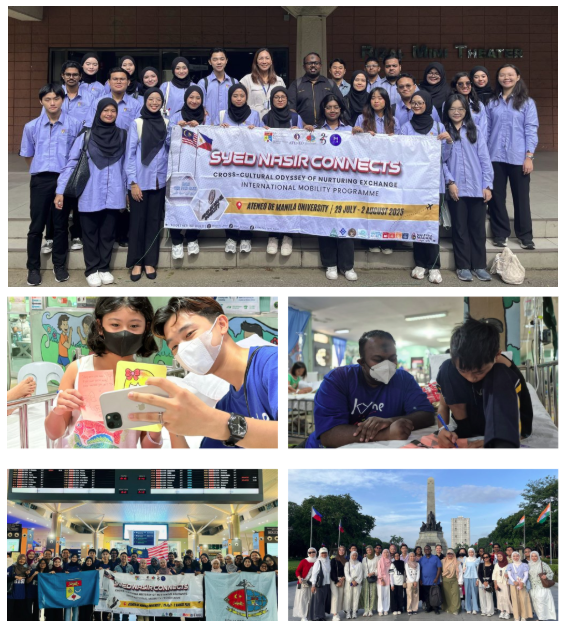
Universiti Kebangsaan Malaysia (UKM) collaborates with non-governmental and community-based organisations to engage students in volunteering activities that contribute directly to the Sustainable Development Goals (SDGs). One example is the Syed Nasir CONNECTS (Cross-Cultural Odyssey of Nurturing Exchange) 2025, an international mobility and outreach programme organised by Tun Syed Nasir Residential College, UKM, from 29 July to 2 August 2025 at Ateneo de Manila University in the Philippines. The programme mobilised 31 UKM student delegates and established collaborative engagement with Philippine healthcare and community organisations, including Kythe Foundation, The Medical City, Philippine Orthopedic Center and Quirino Memorial Medical Center. SDG 17
A significant community-service component of the programme involved UKM students engaging with paediatric cancer patients through Kythe Foundation. Rather than limiting the international programme to academic mobility and institutional visits, the initiative provided students with direct community-service experience involving a vulnerable healthcare population. Through this engagement, students were exposed to the social and emotional dimensions of healthcare and developed greater empathy, emotional intelligence and understanding of patient-centred care. SDG 17
The collaboration demonstrates how UKM uses student volunteering as a mechanism for SDG implementation through partnership with an NGO/community organisation. UKM students became active participants in community engagement while the collaboration with Kythe Foundation provided an established community setting through which students could interact with and support children affected by cancer. This model combines international student mobility with social responsibility and community service, extending student learning beyond the university and into direct engagement with vulnerable communities.
The initiative contributes particularly to SDG 3: Good Health and Well-being through its engagement with paediatric cancer patients and exposure to patient-centred healthcare; SDG 10: Reduced Inequalities through engagement with a vulnerable population; and SDG 17: Partnerships for the Goals through cross-border collaboration between UKM and organisations in the Philippines. Most importantly for Indicator 17.2.5, the programme provides evidence that UKM’s collaboration with external non-governmental/community partners is translated into direct student volunteering and community-service activities addressing sustainable-development needs, rather than being limited to institutional networking or formal partnership agreements.
Source: https://www.ukm.my/ktsn/syed-nasir-connects-2025-pengembaraan-global-ktsn-ke-filipina/
ii. Creative Recycling Project: Empowering Young Innovators for Community Impact
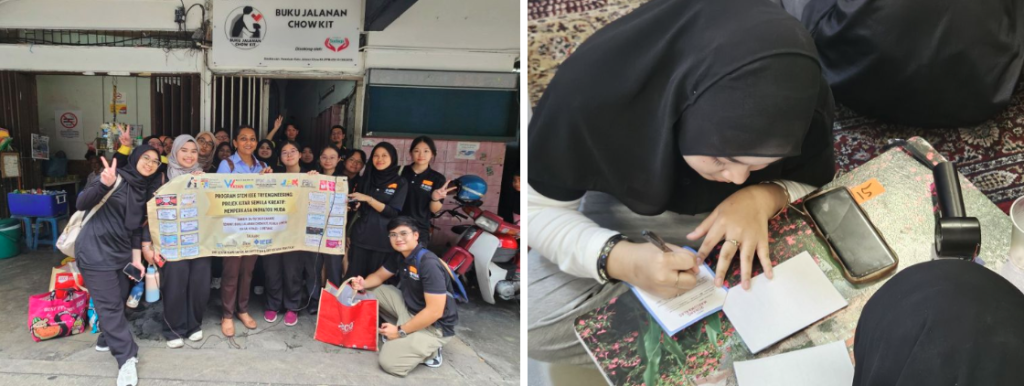
On 26 October 2025, Universiti Kebangsaan Malaysia (UKM), through the IEEE UKM Student Branch and its student volunteers, collaborated with Buku Jalanan Chow Kit (BJCK), a non-governmental organisation (NGO) providing educational opportunities to stateless and underserved children, to implement the Creative Recycling Project: Empowering Young Innovators for Community Impact (Final Edition).
The community service initiative was organised by the IEEE UKM Student Branch 2025/2026, in collaboration with the IEEE EDS UKM Student Branch Chapter, IEEE PES UKM Student Branch Chapter and students of Universiti Kebangsaan Malaysia, with support from the IEEE TryEngineering STEM Grant 2025.
The programme brought together 21 student volunteers and 50 children aged 10–17 years at Buku Jalanan Chow Kit. Through interactive workshops and collaborative activities, UKM students engaged directly with children from the stateless and underserved community, providing hands-on learning experiences designed to stimulate interest in STEM, creativity, innovation and environmental sustainability.
The project incorporated sustainability and recycling concepts into STEM learning activities, enabling participants to explore scientific and engineering concepts through practical and interactive approaches. In addition to transferring STEM knowledge, the programme encouraged young participants to develop creative solutions to community and environmental challenges and introduced sustainable practices such as recycling.
This collaboration directly demonstrates UKM’s engagement with an NGO in addressing the Sustainable Development Goals through student volunteering programmes. UKM student volunteers acted as facilitators and knowledge-transfer agents, working directly with BJCK and its beneficiary community to expand access to informal STEM education for children who face barriers to conventional educational opportunities.
The programme also strengthened the relationship between the university, students and the NGO, promoting mutual learning and understanding. The collaboration therefore extended beyond charitable assistance by using student expertise, experiential learning and structured educational activities to address educational and social inequalities within an underserved community.
The initiative contributes particularly to SDG 4 (Quality Education) by expanding access to STEM learning opportunities; SDG 10 (Reduced Inequalities) by engaging stateless and underserved children; SDG 12 (Responsible Consumption and Production) through recycling and environmental sustainability education; and SDG 17 (Partnerships for the Goals) through structured collaboration between UKM students and Buku Jalanan Chow Kit.
Source : https://events.vtools.ieee.org/m/518767
iii. SULAM Bangkuthon UKM @ Denai Sungai Langat
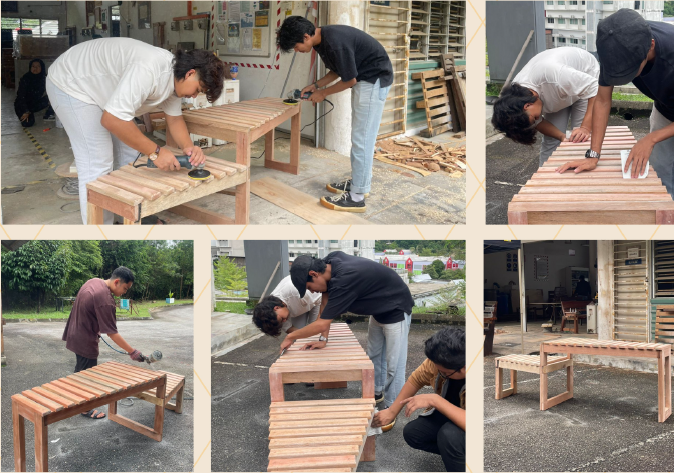
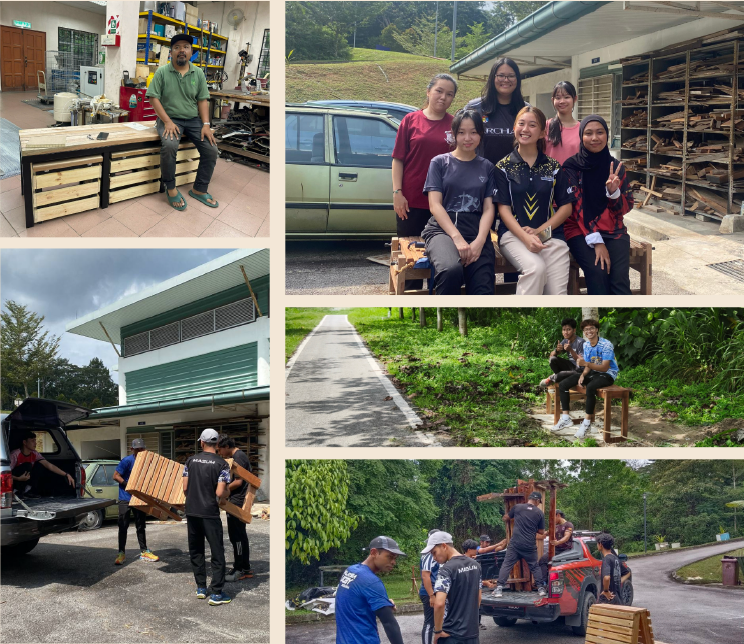
Universiti Kebangsaan Malaysia (UKM) implemented the SULAM Bangkuthon UKM @ Denai Sungai Langat project during Semester 1 of the 2024/2025 academic session, culminating in the official launch of the completed project on 17 January 2025.
The service-learning initiative integrated two UKM courses: LMCR1102 Kesukarelawanan Khidmat Bakti (Volunteerism and Community Service) offered by the School of Liberal Studies (CITRA), and KKAB2313 Teknologi Bahan dan Binaan 2 (Materials and Construction Technology 2) involving the Faculty of Engineering and Built Environment (FKAB).
Approximately 100 UKM students from various faculties participated in the initiative. Through the project, students applied volunteerism, community engagement and technical knowledge to develop six benches made from recycled hardwood and reused materials. The completed benches were installed along Denai Sungai Langat, providing practical facilities for users of the river trail while supporting UKM’s wider sustainability agenda.
The project illustrates UKM’s service-learning approach in which students apply academic and technical knowledge to address real community and environmental needs. Rather than limiting student participation to awareness activities, the programme enabled students to create a tangible and sustainable output for the Sungai Langat environment.
The programme was also connected with the wider river-conservation stakeholder network surrounding Denai Sungai Langat. The official launch included the participation of the Deputy President of Friends of Langat River, alongside representatives of UKM and the Hulu Langat District Department of Irrigation and Drainage. Friends of Rivers organisations have been involved in UKM’s broader efforts to promote river conservation, environmental awareness and community participation along Sungai Langat.
The initiative supports SDG 4 (Quality Education) through experiential and service-based learning; SDG 11 (Sustainable Cities and Communities) through improvements to shared community spaces; SDG 12 (Responsible Consumption and Production) through the reuse of materials and recycled hardwood; SDG 15 (Life on Land) through environmental stewardship; and SDG 17 (Partnerships for the Goals) through engagement among the university, students and river-conservation stakeholders.
iv. Santunan Kasih : UKM Kongsi Rezeki 2025
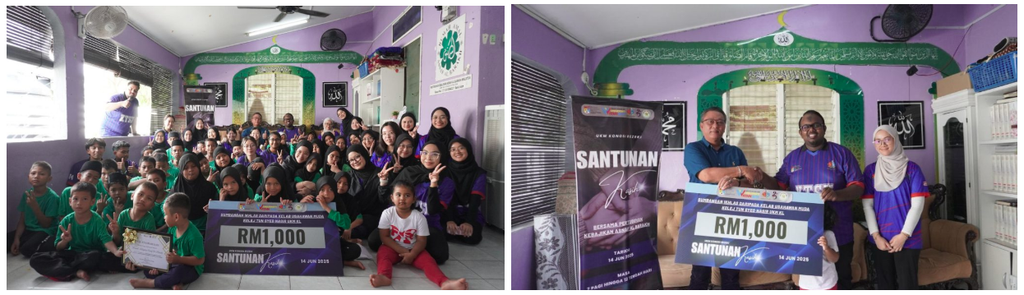
Universiti Kebangsaan Malaysia (UKM) collaborates with community and non-governmental organisations to mobilise students in volunteering programmes that address social needs and contribute directly to the Sustainable Development Goals (SDGs). One example is the Santunan Kasih: UKM Kongsi Rezeki 2025 programme organised by the Young Entrepreneurs Club (Kelab Keusahawanan Muda), Kolej Tun Syed Nasir (KTSN), UKM, in collaboration with Pertubuhan Kebajikan Asnaf Al-Barakh, Selangor. The community-service programme was conducted on 14 June 2025 at the welfare organisation and focused on supporting vulnerable members of the community through inclusive and meaningful volunteer activities.
The programme mobilised 33 UKM students to participate directly in community service at the welfare centre. Their volunteering activities included communal cleaning (gotong-royong) of the prayer hall, library, female dormitory, kitchen, canteen and surrounding residential areas. The students also helped improve the physical environment of the centre and established a dedicated reading corner, adding an educational element to the existing facilities available to its residents.
Beyond improving the facilities, UKM students engaged directly with the children at the welfare centre through recreational activities and social interaction. The programme therefore provided students with an opportunity to apply the values of volunteerism, empathy, social responsibility and community engagement while contributing tangible support to a disadvantaged community. UKM specifically identified the development of empathy and concern for less fortunate communities as an objective of the programme.
The volunteering initiative also addressed several dimensions of sustainable development. UKM students prepared breakfast for residents of the welfare centre, supporting SDG 2: Zero Hunger by contributing to access to nutritious food among vulnerable groups. The communal cleaning activities promoted a clean and healthy living environment, contributing to SDG 3: Good Health and Well-being, while the wider effort to strengthen social inclusion and improve the quality of life of a vulnerable community contributes to SDG 11: Sustainable Cities and Communities. UKM’s official programme page explicitly associates these activities with the respective SDGs.
The engagement was further supported through a financial contribution, with UKM presenting RM1,000 to Pertubuhan Kebajikan Asnaf Al-Barakh, alongside a certificate of appreciation to the organisation. The welfare-centre management acknowledged the students’ commitment to the programme, particularly their willingness to participate in communal activities and interact with the children.
Source: https://www.ukm.my/ktsn/santunan-kasih-ukm-kongsi-rezeki-2025/
v. UKM Cakna OKU × Yayasan FAQEH
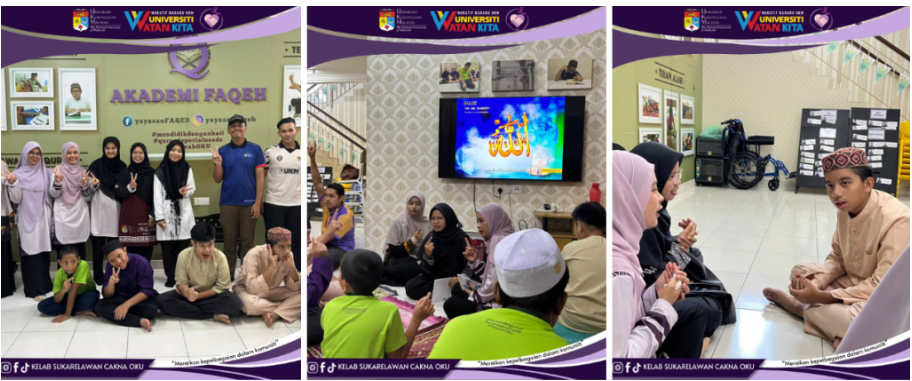
Universiti Kebangsaan Malaysia (UKM) collaborates with non-governmental and community-based organisations to mobilise students in volunteering activities that promote social inclusion and support persons with disabilities (PWD). One example is the Volunteer Outreach Programme: UKM Cakna OKU Visit to Yayasan FAQEH (Series 2), conducted on 14 June 2025 by the UKM Cakna OKU Volunteer Club in collaboration with Yayasan FAQEH. The programme was specifically designed to strengthen students’ awareness and empathy towards the disability community while building a closer collaborative relationship between UKM volunteers and the foundation.
The initiative provided UKM student volunteers with direct exposure to disability-related community engagement, allowing volunteering to function as a form of experiential learning. UKM states that the programme sought to cultivate empathy and social responsibility among volunteers and inspire greater participation in supporting persons with disabilities. This demonstrates that the collaboration extended beyond institutional networking: students themselves were the participants through whom the university’s community-engagement objectives were implemented.
Importantly, the outreach sits within a broader UKM–Yayasan FAQEH partnership in inclusive education. UKM’s Community-Based Rehabilitation Centre (PPDK UKM) implements the QurANIS inclusive Quran education initiative in collaboration with Yayasan Pendidikan al-Quran bagi Anak Istimewa (FAQEH). The programme uses a specialised QurANIS curriculum developed for children with special educational needs, while volunteer instructors from UKM’s Faculty of Education and the Cakna OKU Volunteer Club contribute to its delivery.
The initiative contributes particularly to SDG 4: Quality Education by supporting inclusive learning opportunities for persons with special educational needs; SDG 10: Reduced Inequalities by promoting disability inclusion and reducing social barriers faced by persons with disabilities; and SDG 17: Partnerships for the Goals through collaboration between UKM and Yayasan FAQEH in mobilising volunteers and expertise for community-based inclusive education.
Source: https://www.facebook.com/share/p/18JEi8tkyq
vi. National Antarctica Day 2025 × Yayasan Penyelidikan Antartika Sultan Mizan (YPASM)
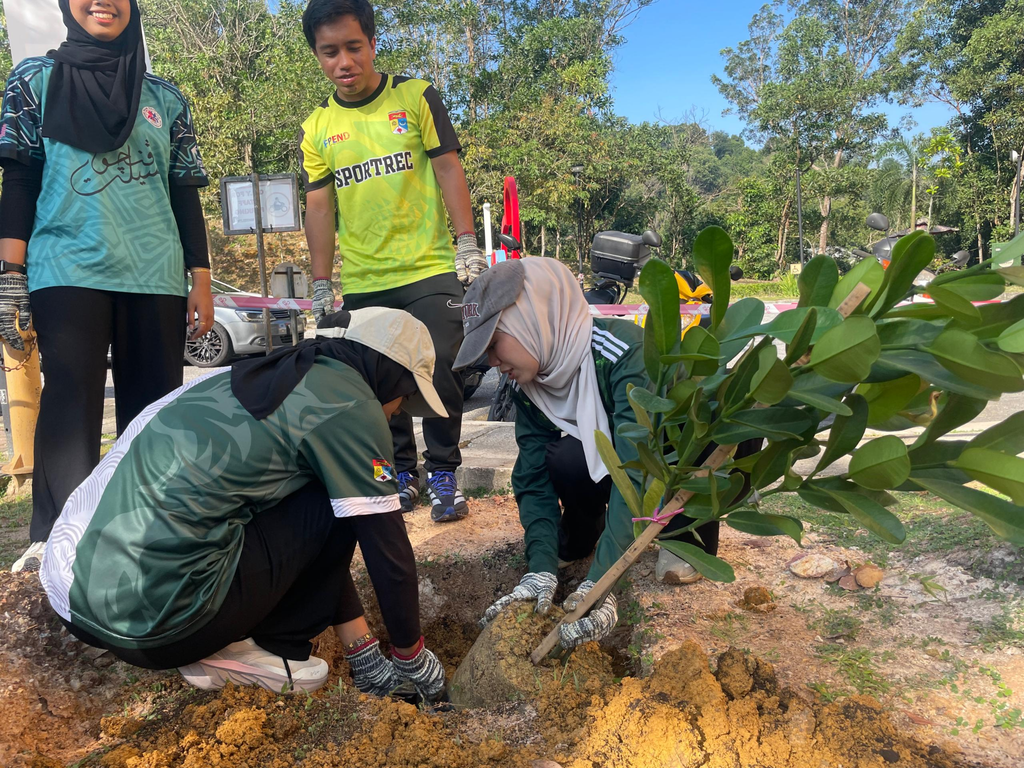
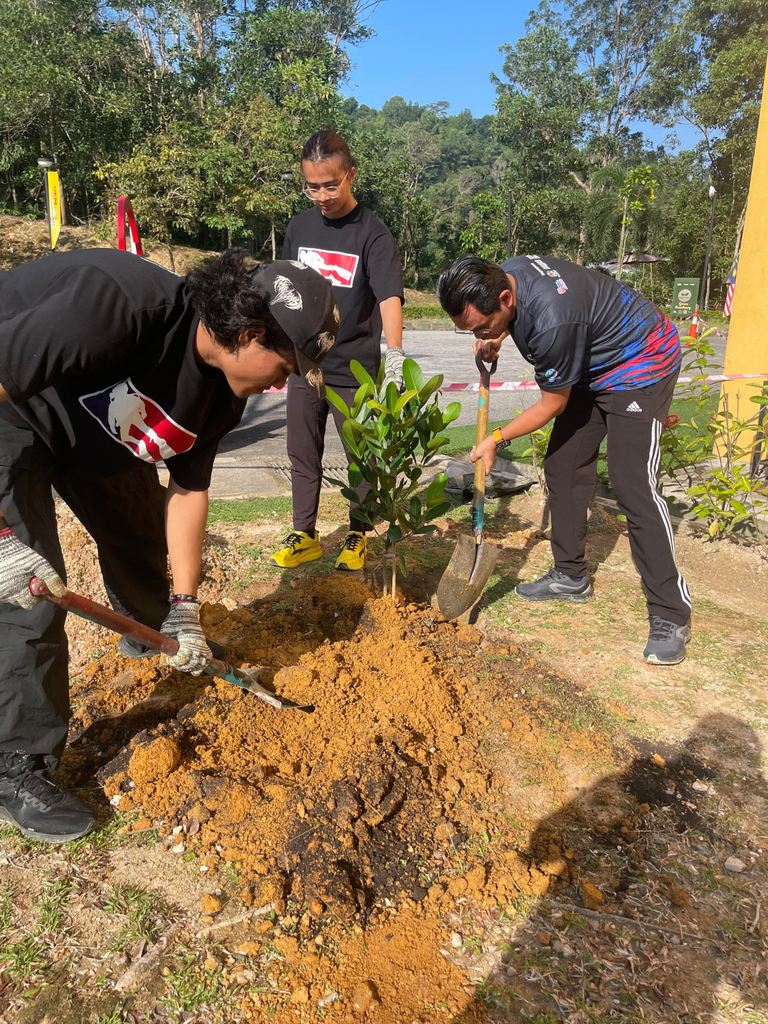
Universiti Kebangsaan Malaysia (UKM) collaborates with external organisations to engage its university community and youth in environmental volunteering activities that contribute to the Sustainable Development Goals. One example is the National Antarctica Day 2025 (Sambutan Hari Antartika Peringkat Kebangsaan 2025), held on 1 December 2025 as part of a coordinated national sustainability initiative involving 12 Malaysian universities. At UKM, the programme was organised by the Institute of Climate Change (IPI), UKM, in collaboration with the UKM Strategy Centre, with the national initiative coordinated by the Sultan Mizan Antarctic Research Foundation (Yayasan Penyelidikan Antartika Sultan Mizan – YPASM) and supported by TNB.
As part of the celebration, UKM organised a tree-planting activity around the university campus, providing a practical environmental action through which the university community and youth could participate in sustainability efforts. The programme went beyond ceremonial observance of Antarctica Day by connecting environmental action with education and awareness concerning climate change, Malaysia’s involvement in polar research, and sustainability education. UKM’s official announcement specifically states that the national programme brought together the academic and youth communities to strengthen awareness of these issues.
Through the tree-planting activity, participants were able to translate sustainability awareness into direct environmental action. This creates a clear connection between the wider issues represented by Antarctica—particularly climate change and environmental protection—and practical action at the local campus level. The programme therefore illustrates how UKM uses partnership-based outreach to encourage young people to become active participants in environmental stewardship rather than simply recipients of sustainability information.
The initiative contributes particularly to SDG 13: Climate Action, by increasing awareness of climate change and connecting it with practical environmental action; SDG 15: Life on Land, through tree planting and environmental stewardship; SDG 4: Quality Education, through sustainability and polar-science awareness; and SDG 17: Partnerships for the Goals, through coordinated collaboration between UKM, YPASM and other national stakeholders.
Source: https://portalwarga.ukm.my/view-buletin-card?id=50323
vii. Coastal Sustainability Programme in Collaboration with Islamic Relief Malaysia
Kuala Langat Selangor
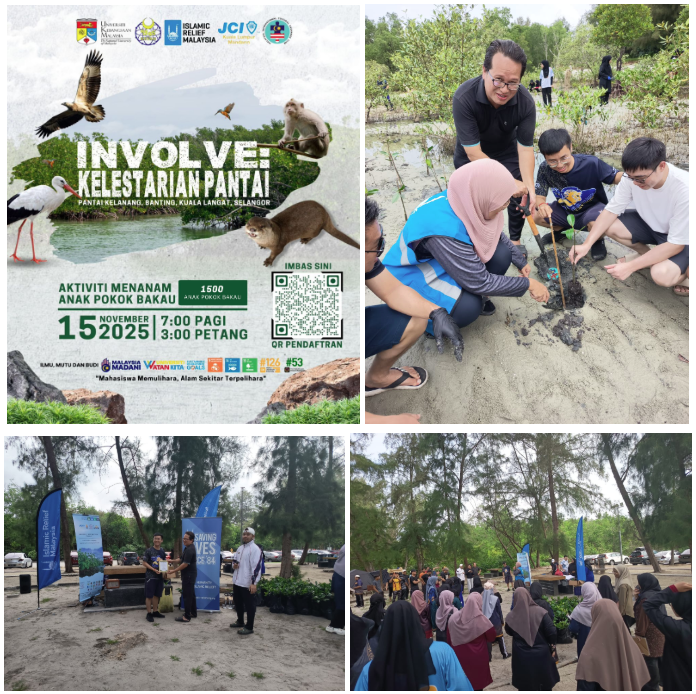
On 15 November 2025, Universiti Kebangsaan Malaysia (UKM), through its Faculty of Islamic Studies, participated in the Involve: Kelestarian Pantai (Coastal Sustainability Programme) at Pantai Kelanang, Banting, Kuala Langat, Selangor. The programme was associated with the PPPH4743 (Islam and the Environment) course and involved collaboration with external organisations, including Islamic Relief Malaysia and JCI Kuala Lumpur Mandarin. It aimed to promote environmental stewardship, coastal ecosystem conservation and student participation in practical sustainability initiatives.
The programme featured mangrove planting activities, with a planned target of 1,500 mangrove saplings, to support the restoration of coastal habitats and strengthen environmental awareness among participating students. By incorporating field-based environmental volunteering into academic learning, UKM provided students with opportunities to apply Islamic principles of environmental responsibility, particularly the concepts of khalifah (stewardship) and amanah (responsibility), in addressing real-world ecological challenges.
This initiative demonstrates UKM’s commitment to SDG 17 (Partnerships for the Goals) through engagement with non-governmental organisations in community-based environmental conservation. It also contributes to SDG 13 (Climate Action), SDG 14 (Life Below Water), and SDG 15 (Life on Land) by supporting coastal resilience, marine habitats and biodiversity conservation. The collaboration illustrates how UKM integrates academic learning, student volunteering and NGO partnerships to advance sustainable development beyond the university campus.
Source : https://www.instagram.com/p/DRKdP8VE4SM/
B. Research Programmes
i. SULAM Asli-Pimpin: Jalinan Mesra Watan @ Chini 2025 – Research Collaboration with MyFund Action
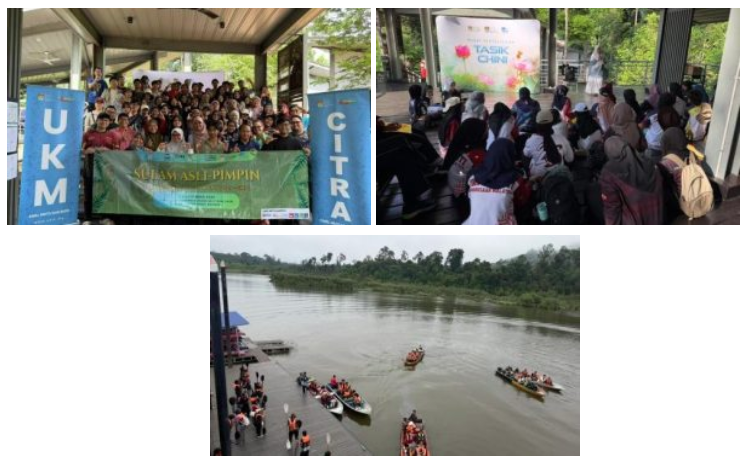
Universiti Kebangsaan Malaysia (UKM) collaborated with MyFund Action, Pahang Branch, alongside local communities and government-related stakeholders, through the SULAM Asli-Pimpin: Jalinan Mesra Watan @ Chini 2025 (Series 2), held from 7 to 9 November 2025 at the Tasik Chini Research Centre (PPTC), ALAF-UKM and Orang Asli settlements surrounding Tasik Chini. The programme was jointly organised by the UKM-TR2024-07 and ALAF-2025-001 research groups, with the participation of the Orang Asli Village Development and Security Committees (JKKPOA) of Kampung Gumum and Kampung Melai, Pahang State Parks Corporation (PTNP), and MyFund Action.
The collaboration incorporated a strong research and community-based learning component, involving 63 UKM students from the School of Liberal Studies (CITRA), Faculty of Information Science and Technology (FTSM), and Faculty of Science and Technology (FST). Through household visits, community interaction and field exploration, participants gathered first-hand knowledge concerning the lifestyles, local and indigenous knowledge, socioeconomic circumstances, and environmental relationships of Orang Asli communities around Tasik Chini. Field activities within the forest and lake environment also enabled students to understand the ecological significance of the Tasik Chini UNESCO Biosphere Reserve and the relationship between environmental conservation and the well-being of surrounding indigenous communities.
The involvement of MyFund Action as an NGO partner within this multi-stakeholder research and engagement platform demonstrates UKM’s approach to addressing the SDGs through collaborative knowledge generation rather than one-way community assistance. Community perspectives and indigenous knowledge were incorporated into experiential field research, connecting academic inquiry with real social and environmental challenges.
Through this collaboration, UKM integrates research, NGO participation, student learning and community knowledge to address interconnected issues relating to indigenous communities, social inclusion and environmental sustainability. The initiative therefore provides evidence of UKM’s collaboration with NGOs through research programmes addressing the SDGs, particularly SDG 10 (Reduced Inequalities), SDG 15 (Life on Land), and SDG 17 (Partnerships for the Goals).
Source: https://www.ukm.my/citra/aktiviti/
ii. Research-Based Islamic Art Exhibition: Funduq – Legacy of Excellence of the Malay World
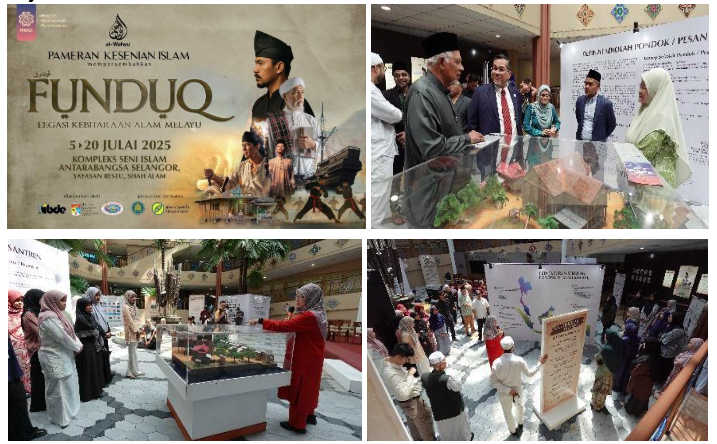
Universiti Kebangsaan Malaysia (UKM), through the Institute of the Malay World and Civilization (ATMA), collaborated with external organisations and NGOs in translating research on the Malay World and Islamic civilisation into public knowledge and cultural engagement through the Al-Wahyu Islamic Art Exhibition, “Funduq: Legasi Kebitaraan Alam Melayu” (Funduq: Legacy of Excellence of the Malay World), held from 5–20 July 2025 at the Selangor International Islamic Arts Complex, Shah Alam.
The exhibition was research-based, drawing upon field research on traditional Islamic educational institutions, particularly pondok and pesantren, across the Malay World. As part of the research process, a research team led by Ts. Dr. Ros Mahwati Ahmad Zakaria, who served as the exhibition curator, conducted field research at three major pondok pesantren in Surabaya, Indonesia, from 2–5 June 2025. The findings and materials generated through this research contributed to the exhibition’s presentation of the history, characteristics and development of traditional pondok and pesantren education across Malaysia, Indonesia, Southern Thailand, Singapore and Brunei.
The research outcomes were subsequently translated into an accessible public exhibition featuring historical information, photographs, manuscripts and other materials relating to Islamic scholarship and educational traditions in the Malay World. Among the materials presented were photographs of handwritten kitab turath manuscripts more than 100 years old from Pondok Pesantren Langitan in Surabaya, as well as information on prominent scholars associated with the pondok and pesantren tradition.
Importantly, as shown in the official programme poster, the initiative involved collaboration between UKM/ATMA and several external organisations, including Yayasan Turath, Yayasan Restu, Selangor Research Institute (SRI) and IBDE. This partnership enabled academic research expertise to be combined with the knowledge, networks and cultural-preservation activities of external and civil-society organisations.
Through this collaboration, UKM research was extended beyond conventional academic outputs and transformed into a research-based knowledge-transfer and public-engagement programme. The Funduq exhibition therefore demonstrates UKM’s engagement with NGOs and external organisations in conducting, translating and disseminating research related to the heritage, intellectual traditions and civilisation of the Malay World.
The initiative provides strong evidence for 17.2.5 – Research Programmes, demonstrating a clear pathway of field research → UKM academic expertise → NGO/external organisation collaboration → research-based exhibition → public knowledge dissemination and cultural preservation, thereby strengthening university–civil society partnerships in support of SDG 17: Partnerships for the Goals.
Source:
https://festivalturathislami.my/berita/2025/pameran-al-wahyu-papar-sejarah-kitab-turath-ulama-alam-melayu-dibuka-secara-rasmi
https://www.ukm.my/atma/kelestarian/2025-pameran-kesenian-islam-yang-bertemakan-funduq-legasi-kebitaraan-alam-melayu/
iii. Research Collaboration with Persatuan Linguistik Malaysia (PLM) – Karnival Memadanikan Cyberjaya
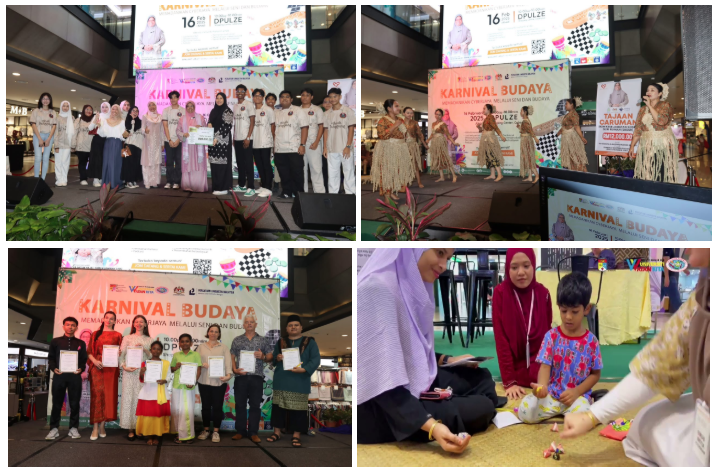
Universiti Kebangsaan Malaysia (UKM), through the Institute of the Malay World and Civilization (ATMA), collaborated with Persatuan Linguistik Malaysia (PLM), a non-governmental professional association, in implementing a research initiative that connected academic research with community and cultural engagement.
The collaboration was supported through a RM50,000 National Industry Research Grant awarded by Persatuan Linguistik Malaysia (PLM) to Dr. Mohd Faizal Musa, Research Fellow at ATMA, UKM, for the research project “Memadanikan Cyberjaya: Pengaplikasian Digital menerusi Pelestarian Budaya” (Civilising Cyberjaya: Digital Applications through Cultural Preservation).
As part of the implementation and community engagement associated with this research initiative, the Karnival Memadanikan Cyberjaya provided a platform for translating the research agenda into activities involving the wider community. The programme connected the research themes of language, culture, digital applications and cultural preservation with public engagement, enabling research knowledge and cultural understanding to be shared beyond the university environment.
The involvement of PLM was particularly significant as the organisation supported the underlying research through dedicated grant funding, while UKM, through ATMA and its researchers, contributed academic expertise, research capacity and programme implementation. The Karnival Memadanikan Cyberjaya therefore demonstrates how an NGO-supported research grant can be translated into research-based community engagement and knowledge dissemination activities.
Through this initiative, UKM demonstrates its commitment to working directly with NGOs in research programmes, knowledge generation, cultural preservation and community engagement. The collaboration between UKM and PLM also illustrates how externally funded research can generate wider societal impact by connecting academic research with communities, thereby contributing to SDG 17: Partnerships for the Goals.
C. Development of Educational Resources
i. UKM–UNICEF Collaboration in Developing National Disaster Risk Reduction Educational Resources for Primary Schools
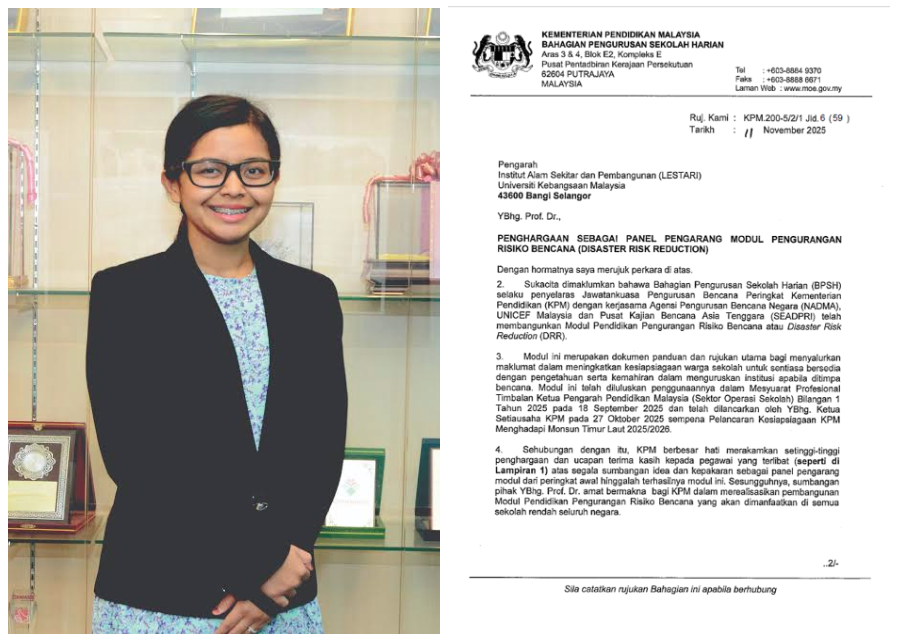
In 2025, Universiti Kebangsaan Malaysia (UKM), through its Institute for Environment and Development (LESTARI), contributed academic expertise to the development of the national Disaster Risk Reduction (DRR) Education Module for Malaysian primary schools. This initiative demonstrates UKM’s commitment to developing educational resources that strengthen disaster preparedness, risk awareness and resilience among school communities, supporting the achievement of the Sustainable Development Goals (SDGs).
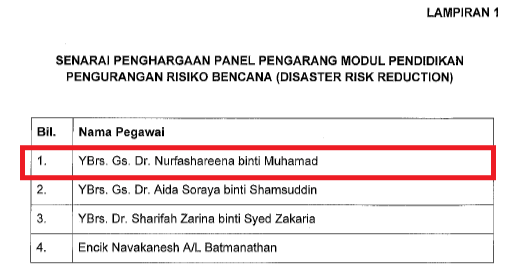
The initiative involved the Ministry of Education Malaysia (MOE), the National Disaster Management Agency (NADMA), UNICEF Malaysia and the Southeast Asia Disaster Prevention Research Initiative (SEADPRI). UKM’s academic contribution was formally recognised through an appreciation letter issued by the Ministry of Education on 11 November 2025, acknowledging Gs. Dr. Nurfashareena Muhamad and other contributors as members of the module’s authoring panel.
The educational module was developed as a national reference and teaching resource to enhance disaster risk awareness and preparedness among primary school students and school communities. Its use was officially approved by the Ministry of Education on 18 September 2025, and the module was subsequently launched on 27 October 2025 in conjunction with the ministry’s preparations for the 2025/2026 Northeast Monsoon.
Complementing this initiative, UKM undertook the UNICEF-funded research project Study on Enhancing Knowledge and Awareness of Disaster Risk Reduction for Students of the Ministry of Education Malaysia during 2024–2025, led by Gs. Dr. Nurfashareena Muhamad. The project reflects UKM’s broader engagement in research and international collaboration to strengthen disaster risk education.
Through its recognised contribution to developing an educational resource intended for primary schools nationwide, UKM demonstrates its commitment to extending academic expertise beyond the university and supporting wider community education. The initiative contributes to SDG 4 (Quality Education), SDG 11 (Sustainable Cities and Communities), SDG 13 (Climate Action) and SDG 17 (Partnerships for the Goals) by strengthening disaster preparedness education, institutional collaboration and community resilience.
ii. IPT Youth Health Programme Module Development Workshop – UKM × Malaysian AIDS Council × Malaysian AIDS Foundation
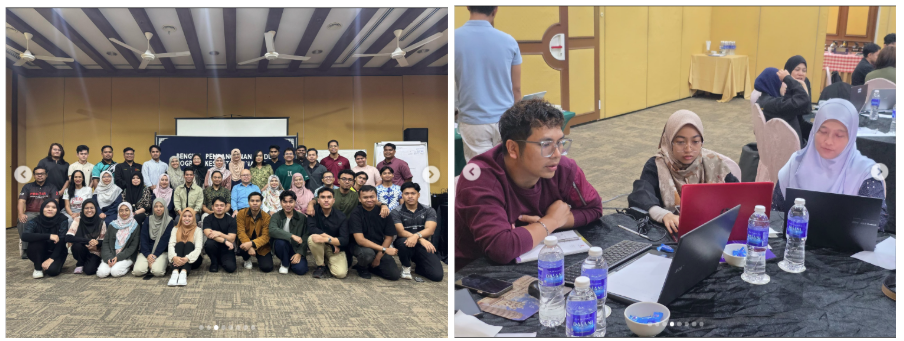
Universiti Kebangsaan Malaysia (UKM) collaborates with non-governmental organisations (NGOs) in the development of educational resources addressing public-health and sustainable-development challenges. A strong example is the IPT Youth Health Programme Module Development Workshop, conducted from 18 to 21 April 2025 by the UKM University Health Centre (PKU) in collaboration with the Malaysian AIDS Council (MAC) and Malaysian AIDS Foundation (MAF), together with the Ministry of Health Malaysia and community volunteers. The four-day programme involved approximately 100 participants and was supported by participating NGOs.
Importantly, the collaboration centred on the development and delivery of a youth health educational module, providing a structured mechanism for translating specialist health knowledge into educational content suitable for university students and student leaders. The programme addressed key youth-health issues including HIV infection risks, HIV prevention, sexually transmitted infections, unplanned pregnancies, peer support and psychosocial competencies. It also sought to correct misconceptions surrounding sexual and reproductive health by providing participants with accurate, scientifically grounded information.
The educational approach extended beyond conventional health-awareness activities. Student leaders were equipped with knowledge and practical competencies for peer education and peer support, including assertive skills to respond to peer or partner pressure and greater awareness of personal responsibility in relation to sexual, reproductive and mental health. In this way, participants were prepared not simply as recipients of health information but as agents of change capable of communicating appropriate health knowledge within the wider student community.
This collaboration contributes particularly to SDG 3: Good Health and Well-being, through HIV prevention, sexual and reproductive health awareness and psychosocial well-being; SDG 4: Quality Education, through the development and delivery of structured health education; and SDG 17: Partnerships for the Goals, through collaboration between UKM, NGOs, government and community stakeholders.
Source : https://www.instagram.com/p/DI3MTE_Tydq/?stkn=cnl3Y3k2aXNuNG9x
iii. SULAM Asli-Pimpin: Jalinan Mesra Watan @ Chini 2025
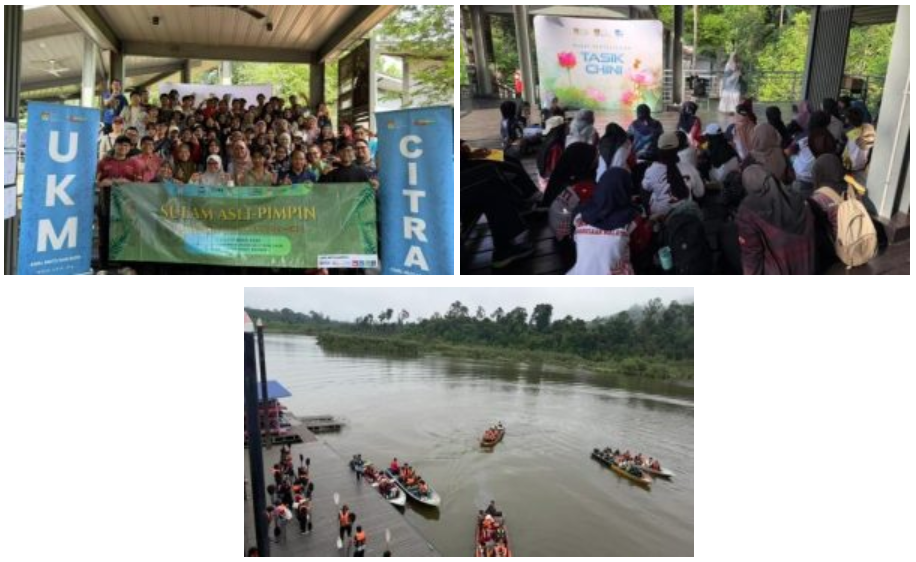
Universiti Kebangsaan Malaysia (UKM), in collaboration with MyFund Action, Pahang Branch and other community and institutional stakeholders, used the SULAM Asli-Pimpin: Jalinan Mesra Watan @ Chini 2025 (Series 2) as a platform to transform field-based knowledge into an educational resource promoting awareness of the Orang Asli community and the Tasik Chini UNESCO Biosphere Reserve.
A significant output-oriented component of the programme was the planned transformation of knowledge and observations gathered during the field activities into a module for the development of an online educational game. During the programme, UKM students engaged directly with Orang Asli households, explored the surrounding forest and lake ecosystems, and learned about indigenous lifestyles, local knowledge, socioeconomic conditions and community relationships with the Tasik Chini environment. These experiences provided contextual information that could subsequently inform the content and design of the educational module.
This approach demonstrates how UKM’s collaboration with an NGO extends beyond conventional volunteering or community outreach. Through the participation of MyFund Action within the wider partnership, the programme connected university expertise, NGO engagement, indigenous community knowledge and student participation with the creation of an educational resource intended to strengthen public awareness and advocacy concerning the Orang Asli community and environmental conservation at Tasik Chini.
The proposed online game module provides a mechanism for translating research findings and community-based knowledge into an accessible educational format, potentially extending the impact of the programme beyond its immediate participants. It also demonstrates an innovative approach to Education for Sustainable Development by using digital learning resources to communicate interconnected social, cultural and environmental sustainability issues.
Accordingly, the initiative provides evidence of UKM’s collaboration with NGOs in the development of educational resources addressing the SDGs, particularly SDG 4 (Quality Education) through the creation of sustainability-oriented learning resources, SDG 10 (Reduced Inequalities) through awareness and advocacy concerning Orang Asli communities, SDG 15 (Life on Land) through education on the Tasik Chini Biosphere Reserve, and SDG 17 (Partnerships for the Goals) through multi-stakeholder collaboration.
Source : https://www.ukm.my/citra/aktiviti/
iv. UKM Cakna OKU Volunteer Guidelines × Yayasan FAQEH
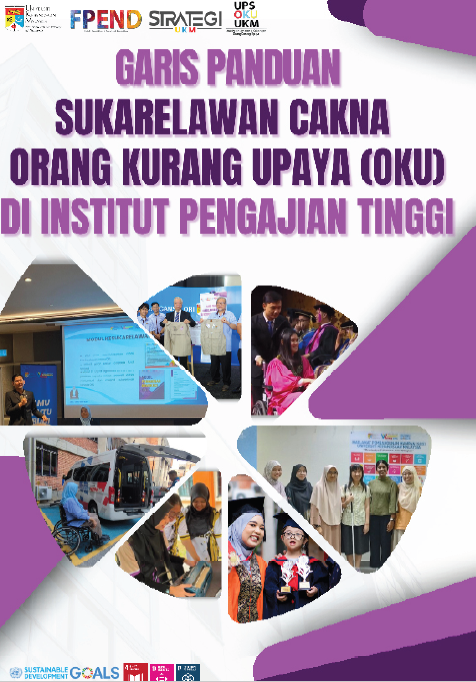
Universiti Kebangsaan Malaysia (UKM) collaborates with non-governmental and community organisations in developing educational resources that strengthen disability inclusion and promote meaningful community participation. A significant example is the Garis Panduan Sukarelawan OKU (Guidelines for Volunteers Supporting Persons with Disabilities), officially launched by UKM on 7 May 2025. The guideline was developed through a UKM sustainability research initiative led by Dr. Syar Meeze Mohd Rashid and involved collaboration with relevant disability stakeholders, including Yayasan FAQEH, as documented in the guideline itself.
The initiative represents more than a conventional awareness programme. Its principal output is a structured educational resource for volunteers, designed to strengthen their understanding of the needs, rights and challenges experienced by persons with disabilities (PWD) and to provide practical guidance for interacting, communicating and working effectively with the disability community. UKM’s PPDK platform describes the Modul Sukarelawan OKU as a project aimed at developing a comprehensive and inclusive disability-volunteering guideline for application across higher education institutions (IPT).
The involvement of Yayasan FAQEH is particularly relevant to THE Indicator 17.2.5 because it demonstrates that the educational resource was developed with engagement beyond the university itself, incorporating the perspective and experience of an organisation working with persons with disabilities and special educational needs. This NGO–university collaboration helps ensure that volunteer guidance is informed not only by academic research but also by practical experience of supporting the target community.
The resource consequently strengthens the capacity of UKM students and other volunteers to undertake disability-related community engagement more appropriately and inclusively. By providing guidance on disability awareness, communication, appropriate interaction and effective support, the guideline helps translate knowledge into practical competencies that volunteers can apply when working directly with persons with disabilities.
This educational-resource development also complements the wider relationship between UKM and Yayasan FAQEH. UKM’s PPDK confirms collaboration with the foundation in delivering QurANIS, an adapted Quranic learning approach for children with special needs. This broader collaboration demonstrates an established relationship in inclusive education and disability support, rather than an isolated NGO involvement.
The initiative contributes particularly to SDG 4: Quality Education by developing an educational resource that builds volunteer knowledge and competencies; SDG 10: Reduced Inequalities by promoting more inclusive and appropriate support for persons with disabilities; and SDG 17: Partnerships for the Goals by bringing together UKM’s academic and research expertise with the experience of an external disability-focused organisation.
Source:
https://www.ukm.my/beritaukm/ukm-lancar-garis-panduan-sukarelawan-oku-pupuk-mahasiswa-inklusif-dan-berempati/
GARIS PANDUAN SUKARELAWAN CAKNA OKU
Collectively, these collaborations demonstrate UKM’s contribution to the SDGs through practical partnerships with civil society. Student volunteers contribute time and skills to community priorities, NGO-supported research connects academic inquiry with societal needs, and jointly developed educational resources strengthen knowledge and capacity beyond individual events. The partnerships combine UKM’s academic expertise with NGOs’ community experience and networks, supporting more relevant and inclusive engagement. Together, they provide tangible examples of university–NGO cooperation in advancing education, health, inclusion, environmental responsibility and SDG 17: Partnerships for the Goals.