

Promote peaceful and inclusive societies for sustainable development, provide access to justice for all and build effective, accountable and inclusive institutions at all levels
SDG 16 Indicator
16.2 – University governance measures
16.2.6 – Academic freedom policy
Universiti Kebangsaan Malaysia (UKM) recognises academic freedom within its institutional governance framework through the constitutional responsibility assigned to the Senate to formulate policies protecting academic freedom and professional excellence. This commitment is complemented by published academic ethics guidance and institutional arrangements supporting research, teaching and scholarly collaboration. Together, these documents provide a foundation for responsible academic inquiry and knowledge dissemination. The Constitution’s explicit protection mandate should be read alongside the relevant approved policies defining academics’ freedom to select research areas and communicate their expertise through public teaching and scholarly discussion.
Academic freedom policy in UKM
| No. | Policy |
|---|---|
| 1. | UKM Constitution : Institutional Commitment to Academic Freedom |
| 2. | UKM Ethics and Academic Excellence |
| 3. | UKM Research Groups |
| 4. | The Center of IDEA (IDEA UKM) |
1. UKM Constitution: Institutional Commitment to Academic Freedom
Universiti Kebangsaan Malaysia (UKM) demonstrates its institutional commitment to academic freedom through the Constitution of Universiti Kebangsaan Malaysia, which assigns the Senate the responsibility of formulating policies to protect academic freedom and professional excellence (UKM Constitution – Page 62). This constitutional responsibility establishes academic freedom as a matter of university governance and provides a foundation for protecting scholarly activities and academic integrity.
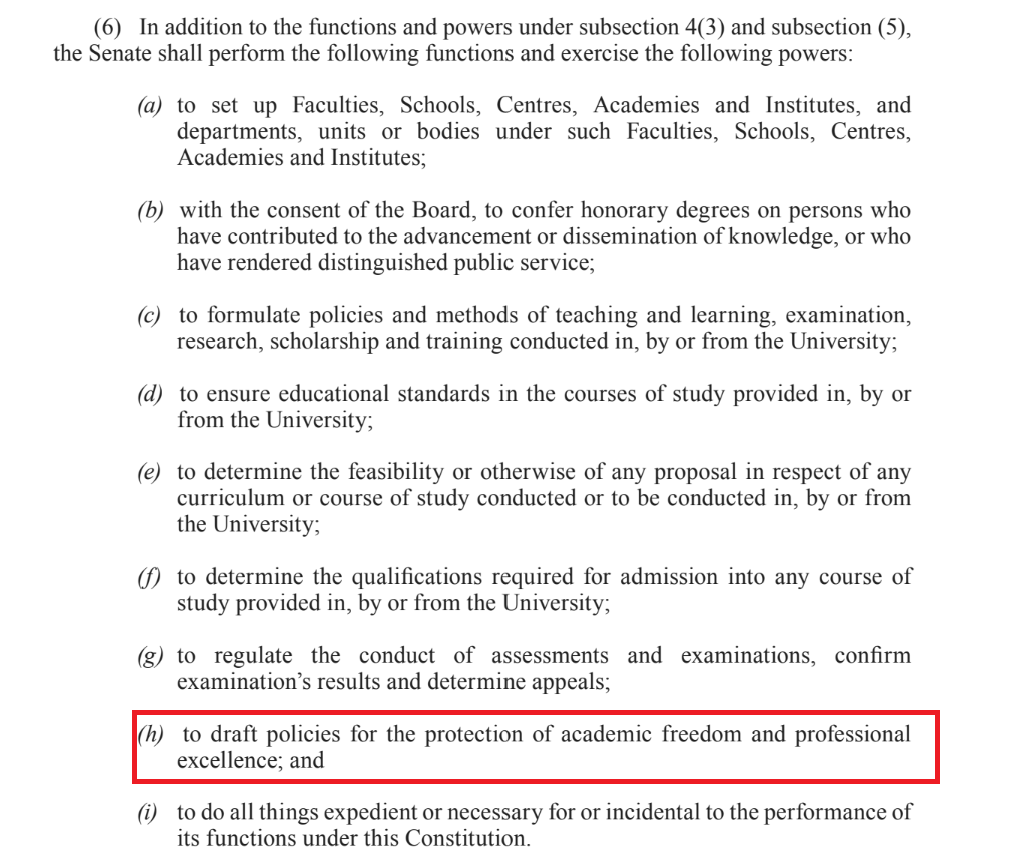
UKM CONSTITUTION 2010
Link: UKM Constitution 2010 (Amendment 2024)
Policy Created : 2010
Policy Amendment: 2024
2. UKM Ethics and Academic Excellence
UKM upholds a policy supporting academic freedom for both senior and junior academics, allowing them to choose their research areas and publicly speak or teach about their work. This is outlined in the UKM Ethics and Academic Excellence 2nd Edition. Based on UKM Ethics and Academic Excellence 2nd Edition, the Academics are encouraged to conduct any research throughout their careers, specifically within their area of expertise, refer to Page 10, Point 1, Section 1.2. Furthermore, UKM supports academics in publicly sharing and teaching their research, refer to Page 12, Point 3, Section 1.2, emphasizing the importance of making their research known to society, which can inspire students to pursue postgraduate and postdoctoral research.


3. UKM Research Groups
Research Groups serve as the backbone for the sustainability of activities led by a cohort of academics with expertise dedicated to advancing scholarly frontiers in research, development, innovation, and commercialization (R&D&I&C). The research conducted is not only fundamental and translational but also poised at the forefront of scholarly, applied, and strategic horizons for the benefit of stakeholders. This platform is envisioned to elevate collaboration among scholars, fostering UKM’s continuity as a premier, world-class research university, supported by Research Groups recognized at the university level.
UKM has developed the Research Group Guidelines as a reference for academic and administrative staff in planning and strengthening Research Groups at Universiti Kebangsaan Malaysia (UKM). These guidelines align with UKM’s research agenda and new narrative, contributing to the university’s ranking at both national and international levels.
| The criteria for the establishment of the UKM Research Group are as follows: | i. Each group is led by an active and permanent researcher holding the position of Professor or Associate Professor. ii. Each group must include at least one young researcher (Grade 52 and below). iii. Each group must have a minimum of five (5) members, including the leader and young researcher. iv. Group membership consists of researchers from various multidisciplinary and transdisciplinary fields. v. A member can only be part of a maximum of two (2) research groups. vi. The performance of research groups is evaluated based on achievements from the past three (3) years. vii. All applications and evaluations of UKM Research Groups will be assessed by the UKM Research Group Evaluation Committee. |
4. The Center of IDEA (IDEA UKM)
Additionally, UKM has established the Center of IDEA (Innovative, Dynamic, Efficient, and Accountable), which is a strategic research and innovation office. Its primary mission is to drive multidisciplinary research initiatives that address national challenges. IDEA UKM introduced Research Clusters aligned with UKM’s Research Niche, Perdana Challenge, Sustainable Development Goals (SDGs), World Economic Forum, ASEAN Forging Forward 2025, the 11th Malaysia Plan, Shared Prosperity Vision, and the Malaysian Urban Forum. These clusters are led by Cluster Leaders who design strategies to strengthen UKM’s research ecosystem and enhance collaborative relationships domestically and internationally. The center’s efforts are supported by all UKM researchers, including both senior and emerging scholars, fostering a robust and dynamic research environment. These clusters promote academic specialization, support cross-disciplinary collaboration, and cultivate high-quality, impactful research.
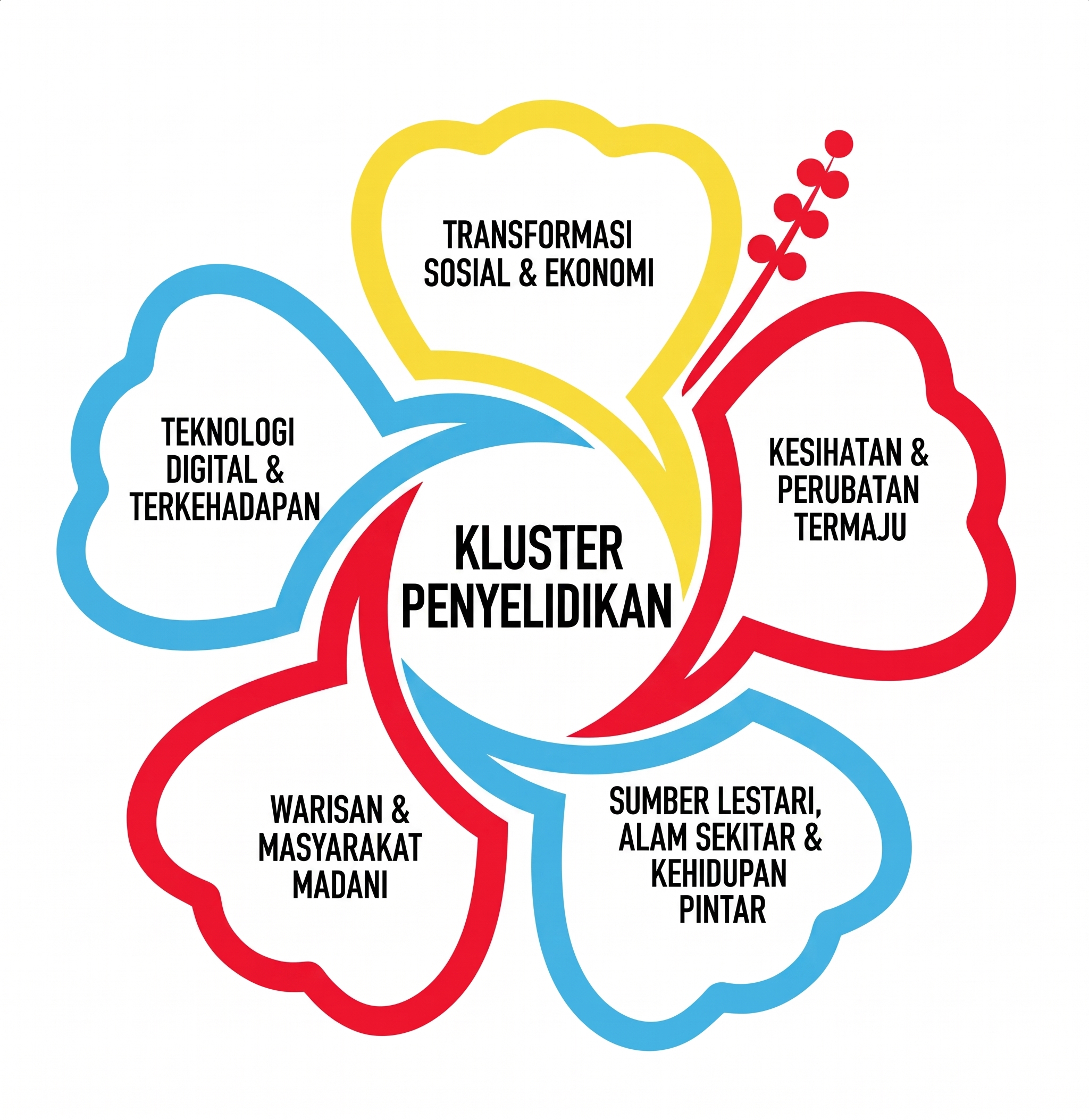
The research cluster consisting of:
- Social and Economic Transformation Cluster: Focusing on globalization and national identity, technology-driven economy and society, social inclusivity, well-being and values, diversity, and future competencies.
- Health and Advanced Medicine Cluster: This cluster emphasizes research in cancer, obesity-related diseases, natural product and drug development, infection and immunology, non-communicable diseases, public health, neuroscience and mental health, regenerative medicine, and healthy aging.
- Sustainable Resources, Environment, and Smart Living Cluster: This cluster focuses on research areas such as renewable energy, climate change, space science, biodiversity and natural heritage, land, water, and air resources, biological resources, food security, smart communities, and material science.
- Heritage and Civil Society Cluster: This cluster explores ethos and human ecology, Islam and social justice, heritage conservation and sustainability, governance and rule of law, and civilization and cultural diversity.
- Digital and Frontier Technology Cluster: Dedicated to advancing research in Fourth Industrial Revolution (4IR) technologies, advanced computing, pervasive technology and connectivity, advanced and sustainable manufacturing, advanced transportation and mobility, advanced structures, and advanced materials.
The role of research cluster are:
- Drive and cultivate impactful research and innovation.
- Facilitate translational and multidisciplinary research.
- Coordinate efforts to translate research outcomes for stakeholder benefit.
- Provide expert research advisory services.
- Monitor, evaluate, and report on research performance.
- Promote researcher expertise and research impact.
Additional link: https://www.ukm.my/ideaukm/en/function-role/
Additional link: www.ukm.my/ideaukm/en/function-role
UKM recognises academic freedom as a foundation for scholarly inquiry, professional excellence and responsible knowledge sharing. Its constitutional framework assigns the Senate responsibility for formulating policies that protect academic freedom and professional excellence, complemented by academic ethics guidance and institutional support for research, teaching, publication and scholarly discourse.
Platforms such as the Centre of IDEA (Innovative, Dynamic, Efficient, and Accountable) and Research Groups provide support for academics to develop ideas, pursue multidisciplinary collaboration and share their expertise with the wider community. These structures help create an enabling environment for academic work grounded in integrity and intellectual rigour. Clearly documented, approved provisions on research choice, teaching and public scholarly expression would further demonstrate how UKM’s constitutional commitment is implemented in practice, strengthening accountability and transparent academic governance in support of SDG 16: Peace, Justice and Strong Institutions.