
Take urgent action to combat climate change and its impacts
SDG 13 Indicator
13.3 – Environmental education measures
13.3.1 – Local Education Programmes on Climate Change
Universiti Kebangsaan Malaysia (UKM) is dedicated to empowering local communities through climate-focused education programs that foster environmental awareness and action. By integrating hands-on initiatives like carbon footprint tracking in schools, sustainable gardening, and recycling workshops, UKM is cultivating a generation of environmentally conscious leaders committed to addressing climate challenges. These programs not only educate but inspire lasting change, reinforcing UKM’s role as a catalyst for sustainable transformation within local communities. UKM recognizes the pivotal role of education in combating climate change. By integrating environmental education into academic programs and campus initiatives, UKM actively contributes to climate awareness, risk mitigation, adaptation, and sustainable development. Our commitment to 100% implementation of SDG 13 ensures that students, staff, and the community are equipped with the knowledge and skills to address the pressing challenges of climate change.
Summary of the local education programmes on climate change
| No | Local Education Programmes on Climate Change at UKM |
|---|---|
| 1 | Postgraduate Education Programs on Climate Change related course |
| 2 | Undergraduate on Climate Change related course |
| 3 | Environmental Education Program or campaign i. Community Food Waste Composting Education Program at the MPAJ Level ii. Planet In Peril: Halting Plastic Pollution On Earth’s Surface Talk iii. School Carbon Footprint Program: Towards a Sustainable Future v. The IPI Seminar Series 1/2024, titled “Eco-lifestyle: Our Beauty, the Beauty of the Environment,” iv. The IPI Seminar Series 3/2024, titled “The Hunt for Biosignatures Beyond Earth?” |
1. Postgraduate Education Programs on Climate Change related course
- Master in Climate Change
Mode: Coursework
Organizer: Institute of Climate Change
Source: www.ukm.my/ipi/mastercoursework - Master in Environmental Management
Mode: Research and Coursework
Organizer: Faculty of Social Sciences & Humanities
Source: www.ukm.my/fssk/v2/?page_id=18858 - Master of Science (Environmental Assessment and Monitoring)
Mode: Coursework
Organizer: Faculty of Science and Technology
Source: www.ukm.my/siswazahfst/environmentalassessmentandmonitoring - Master of Engineering (Environmental)
Mode: Coursework
Organizer: Faculty of Engineering and Built Environment
Source: www.ukm.my/jurutera/en/environmentalengmsc
2) Undergraduate on Climate Change related course
At the undergraduate level, UKM offers an extensive range of courses across various faculties that address climate change, environmental management, sustainable urban planning, renewable energy, and risk mitigation. These courses provide students with the foundational knowledge needed to engage in climate action efforts both academically and professionally.
UKM offers a range of master’s programs directly focused on climate change, environmental management, and sustainable practices. These programs reflect our commitment to training the next generation of climate leaders.
- Faculty of Science and Technology (FST):
Courses such as Environmental Pollution, Solar Energy Technology, Conservation Biology, and Energy Resources and the Environment contribute directly to understanding climate challenges.
Source: www.ukm.my/prasiswazahfst/bukupanduanprasiswazah
- Faculty of Social Science and Humanities (FSSK):
Courses like Climate Change, Environmental Impact Assessment, Hydrology, and Risk and Disaster Management focus on societal responses to climate risks and environmental sustainability.
Source: www.ukm.my/fssk/v2/wpcontent/uploads/2022/10/BukuPanduan20222023.pdf
- Faculty of Engineering and Built Environment (FKAB):
Climate related courses such as Solid Waste Management, Sustainable Urban Planning, Renewable Energy and Energy Management, and Environmental Science equip students with technical knowledge for implementing sustainable infrastructure and engineering solutions.
Source: www.ukm.my/jurutera/ms/bukupanduanprasiswazah2023
3) Environmental Education Program or campaign
Under SDG 13, UKM has established a comprehensive framework for climate education, engaging students and the wider community through both formal academic programs and outreach campaigns. These efforts are designed to provide insights into climate risks, impacts, and early warning systems, as well as promote strategies for mitigation, adaptation, and impact reduction.
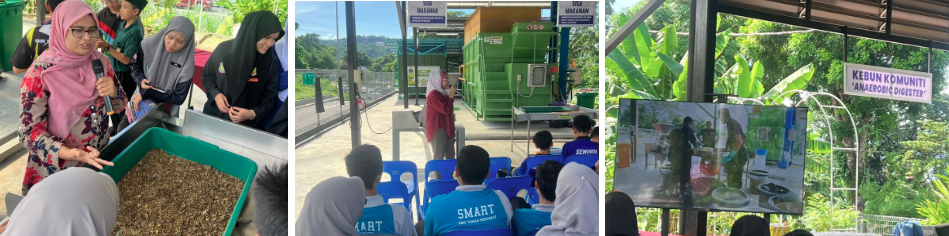
i. Community Food Waste Composting Education Program at the MPAJ Level
The Food Waste Composting Education Program organized by the Faculty of Engineering and Built Environment (FKAB) in collaboration with the Department of Solid Waste Management and Public Cleansing (MPAJ) has a significant impact on both the participating schools and the local community. A total of four schools participated, namely Sekolah Menengah Kebangsaan Pandan Indah, Sekolah Menengah Kebangsaan Taman Keramat, Sekolah Menengah Kebangsaan Bukit Indah, and Sekolah Menengah Kebangsaan Seri Keramat. The program included a Food Waste Composting Briefing Session using the Anaerobic Digester and Black Soldier Fly (BSF) machines, conducted by Puan Nur Suhaiza binti Nyan, Assistant Environmental and Health Officer of MPAJ, as well as a food waste separation demonstration by Dr. Irfana Kabir Ahmad from Universiti Kebangsaan Malaysia. This activity provided participants with more effective exposure to BSF farming and handling.Through this program, students and residents learn the importance of reducing food waste and its environmental impact. The program serves as an impactful climate change education initiative led by Universiti Kebangsaan Malaysia (UKM). This program aims to raise community awareness on the environmental impact of food waste and promote sustainable waste management practices through composting. By converting household food waste into organic compost, the initiative reduces methane emissions from landfills and supports the creation of greener, healthier urban environments.
Source: www.instagram.com/p/C_NGO1MT_uk
ii. “Planet In Peril: Halting Plastic Pollution On Earth’s Surface” Talk
Held on 5 May 2024 at Seminar Room 1, Kompleks Kesatria, Universiti Kebangsaan Malaysia (UKM), the “Planet in Peril: Halting Plastic Pollution on Earth’s Surface” Seminar serves as an educational platform to address the urgent global challenge of plastic pollution and its impact on climate change.
This seminar supports the Tide Turners Plastic Challenge, a global initiative developed by the United Nations Environment Programme (UNEP) and adopted by the World Organization of the Scout Movement (WOSM) under the Earth Tribe initiative. The program encourages youth and communities to take action against plastic waste, fostering environmental stewardship and sustainable lifestyles.
By highlighting the link between plastic pollution and greenhouse gas emissions—from plastic production to degradation—the seminar emphasizes the critical need for reducing single-use plastics, promoting circular economy practices, and integrating climate education into community engagement. Through this effort, UKM continues to advocate for climate resilience, environmental responsibility, and collective action toward a cleaner, healthier planet.
Source: www.instagram.com/p/C6vhpcZSuh7

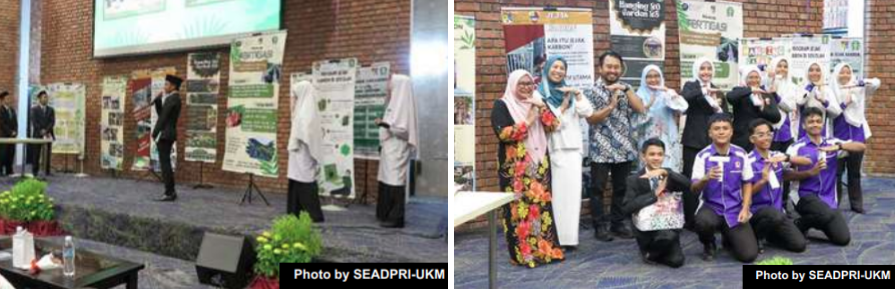
iii. School Carbon Footprint Program: Towards a Sustainable Future
On 14 November 2023, the final presentation ceremony for the School Carbon Footprint Program was held at the Multimedia Fusion Technology Auditorium, Akademia Siber Teknopolis, Universiti Kebangsaan Malaysia (UKM). The event marked the conclusion of the program, which ran from July to November 2023.
The ceremony was attended by approximately 120 students and teachers from Sekolah Berasrama Penuh Integrasi Gombak (INTEGOMB) and Sekolah Menengah Agama Persekutuan Kajang (SMAPK), both of which actively participated in the program. Also present were the principals and representatives from the participating schools.
During the presentations, student groups from both schools showcased various sustainability projects they had implemented, including creating hanging gardens using recycled materials such as plastic bottles, producing compost fertilizer from canteen and dormitory food waste, and recycling used cooking oil into homemade soap. They shared the strategies, methods, and achievements accomplished throughout the program, reflecting their creativity and commitment to reducing their schools’ carbon footprints.
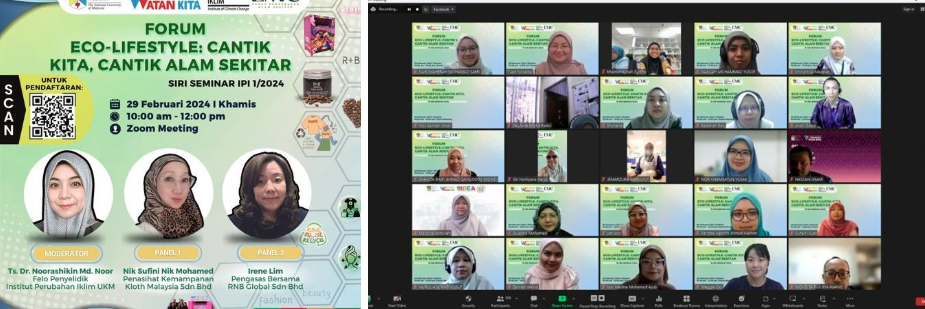
v. The IPI Seminar Series 1/2024, titled “Eco-lifestyle: Our Beauty, the Beauty of the Environment,”
On 26 February 2025 the IPI Seminar Series 1/2024, titled “Eco-lifestyle: Our Beauty, the Beauty of the Environment,” serves as a platform to promote awareness and inspire positive lifestyle changes towards environmental sustainability. Organized by the Institut Pembangunan & Kemajuan Inklusif Malaysia (IPI), this seminar highlights the connection between personal well-being and environmental care emphasizing that a beautiful self reflects a beautiful planet.
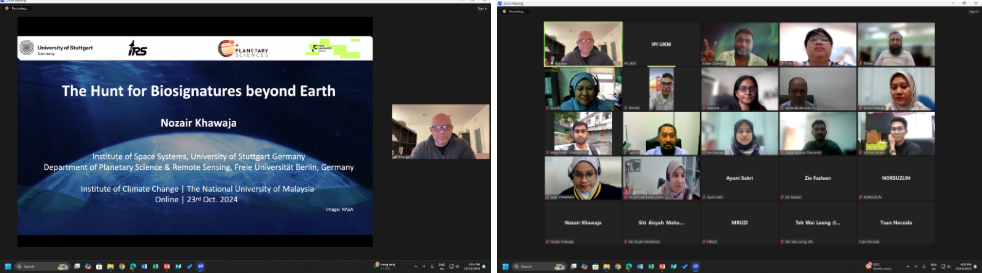
iv. The IPI Seminar Series 3/2024, titled “The Hunt for Biosignatures Beyond Earth?”
On 23 October 2024, The IPI Seminar Series 3/2024, titled “The Hunt for Biosignatures Beyond Earth?”explores one of humanity’s most profound scientific questions: the search for life beyond our planet. Organized by the Institut Pembangunan & Kemajuan Inklusif Malaysia (IPI), this seminar delves into current research and discoveries in astrobiology, planetary science, and space exploration. It highlights how scientists identify potential biosignatures, traces or indicators of life on other celestial bodies such as Mars, Europa, and exoplanets. Through this session, participants gain deeper insight into the interdisciplinary efforts that unite astronomy, biology, and technology in our continuing quest to understand whether we are alone in the universe.