Divestment Policy
Universiti Kebangsaan Malaysia (UKM) supports a sustainability-aligned divestment approach aimed at reducing financial support for environmentally damaging sectors and directing funds towards cleaner and renewable energy sources. This approach is complemented by the UKM Sustainability Strategic Plan 2030 (page 38 and 39) and Green Procurement Guidelines (Page:21, Subtopic 1.11), and is consistent with the low-carbon transition principles of Malaysia’s National Energy Policy 2022–2040, collectively supporting clean energy, resource efficiency and responsible resource allocation.
UKM supports a disposal policy in line with the university’s sustainability goals. The strategy aims to reduce support for environmentally damaging sectors and shift funds toward cleaner and renewable energy sources, promoting a greener and more sustainable future. UKM’s sustainability-aligned approach to investment, procurement and energy management supports the transition towards a low-carbon economy by encouraging responsible resource allocation, clean energy adoption and reduced environmental impacts.
1. UKM Sustainability Strategic Plan 2030
Universiti Kebangsaan Malaysia (UKM), through its Sustainability Strategic Plan 2030, establishes an institutional commitment to advancing clean energy and improving energy efficiency. Under Sustainability Pillar 4: Sustainable Campus, the University prioritises solar energy installation, energy-saving equipment, collaboration on renewable and alternative energy technologies, and low-carbon transportation. On pages 38–39, the plan outlines solar installation, energy-efficient equipment, renewable and alternative energy pilot plants, low-carbon transportation, and centralised energy monitoring. These initiatives are supported by centralised energy management and monitoring, providing a strategic foundation for reducing the carbon footprint of university operations.
- Policy Created: 2022
- Policy Reviewed: 2025
2. National Energy Policy 2022–2040
Universiti Kebangsaan Malaysia (UKM) follows the low-carbon transition principles of Malaysia’s National Energy Policy 2022–2040 as a guiding framework for its sustainable investment approach. In alignment with the UKM Sustainability Strategic Plan 2030, the University commits to progressively reducing and divesting its investment exposure to carbon-intensive energy industries, particularly coal and oil, subject to applicable legal, fiduciary and financial requirements. UKM shall prioritise investments in renewable energy, energy efficiency and clean technologies, supported by periodic monitoring and reporting of progress.
3. UKM Green Procurement Guidelines
UKM’s Green Procurement Guidelines provide a complementary framework that supports the sustainability objectives of the University’s divestment approach. By incorporating environmental, social and economic considerations into purchasing decisions, the guidelines promote environmentally responsible products and services, resource efficiency, and sustainable practices among suppliers and stakeholders. This approach enables UKM to align its procurement expenditure with its broader commitment to reducing environmental impacts and advancing a low-carbon campus.
Together with UKM’s sustainable investment and energy management frameworks, green procurement supports a coordinated approach to responsible resource allocation. While procurement governs the goods and services purchased by the University, divestment addresses its financial investment exposure.
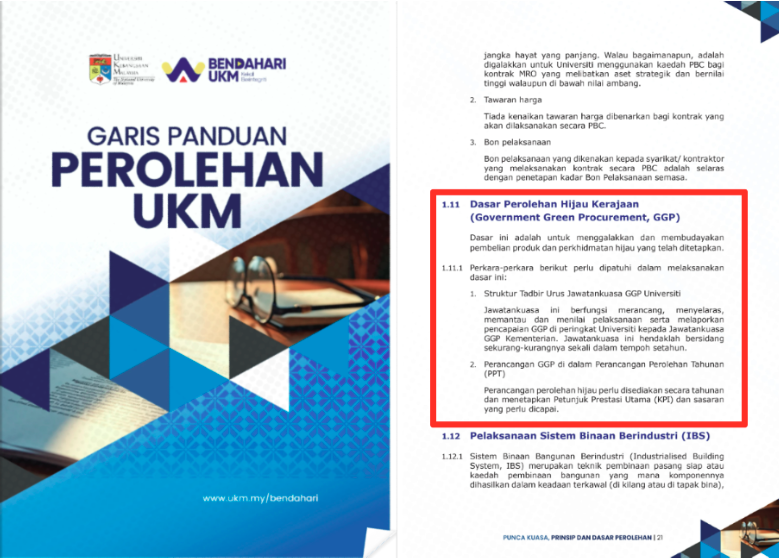
(Page:21, Subtopic 1.11) Procurement Policy that states the guidelines and instructions to prohibit the use of energy efficient products in UKM based on the Green Procurement Policy that had been reviewed in 2025.
Link: https://online.fliphtml5.com/cuqat/eulk/#p=21
4. Fundamental Research Grant Scheme (FRGS) on divesting investments from carbon-intensive energy industries
The Fundamental Research Grant Scheme (FRGS) project on divesting investments from carbon-intensive energy industries reflects a strong commitment to advancing sustainable energy innovation and reducing dependence on fossil fuels. This initiative encompasses a series of groundbreaking research projects that explore alternative, efficient, and environmentally responsible energy solutions. Among them are the Supercapattery as Smart Advanced Energy Storage, which develops hybrid energy storage systems using Porous Coordination Polymer-based composites; the Smart Energy Hospital, focusing on intelligent and efficient energy management for healthcare facilities; the Flexible, Sustainable, and Efficient Energy Harvesting Solar Photovoltaic Panels project, which pioneers adaptable and high-efficiency solar technologies; and the Integration of TRIZ with Patent Mining Technology for Sustainable Energy Efficient Product Innovation, which promotes creative, data-driven approaches to green technology design. Collectively, these projects contribute to Malaysia’s transition toward a low-carbon economy, fostering innovation, energy efficiency, and sustainability in alignment with national and global climate goals.

| Name: | ChM Dr. Mohd Sukor Bin Su`Ait |
| Title Project: | Supercapattery as Smart Advanced Energy Storage utilizing Porous Coordination Polymer-based Hybrid Composites as Electrode Material |
| Sponsor | Engineering, Science and Technology Centre (CREST) |
| Grant Name | Fundamental Research Grant Scheme (FRGS) |
| Amount Pledged | RM 629,127.18 |
| Duration | 4/1/2024 – 3/31/2026 |
The Supercapattery as Smart Advanced Energy Storage project, titled “Utilizing Porous Coordination Polymer-based Hybrid Composites as Electrode Material” (UPM Sub-Project: T04-2023), represents a cutting-edge research initiative aimed at bridging the gap between supercapacitors and batteries. This project focuses on developing advanced hybrid energy storage devices that combine the high power density of supercapacitors with the high energy density of batteries. By leveraging the unique structural and electrochemical properties of Porous Coordination Polymer (PCP)-based hybrid composites, the research seeks to enhance charge–discharge performance, stability, and overall energy efficiency. Ultimately, this innovation contributes to the advancement of next-generation smart energy systems, supporting the transition toward sustainable and efficient energy solutions.

| Name: | Prof. Dr. Norasikin Binti Ahmad Ludin |
| Title Project: | Flexible, Sustainable, and Efficient Energy Harvesting Solar Photovoltaic Panels |
| Sponsor | Petronas Research Sdn. Bhd. |
| Grant Name | Fundamental Research Grant Scheme (FRGS) |
| Amount Pledged | RM 2,000,020.00 |
| Duration | 9/2/2024 – 2/27/2026 |
The Flexible, Sustainable, and Efficient Energy Harvesting Solar Photovoltaic Panels research project aims to develop next-generation solar panels that are lightweight, adaptable, and environmentally friendly. By integrating advanced materials and innovative design, the project seeks to enhance solar energy conversion efficiency while promoting flexibility for diverse applications, supporting the global shift toward clean and sustainable energy solutions.

| Name: | Assoc. Prof. Dr. Ang Mei Choo |
| Title Project: | Integrating TRIZ with Patent Mining Technology for Sustainable Energy Efficient Product Innovation |
| Sponsor | Universiti Tenaga Nasional Sdn. Bhd. |
| Grant Name | Fundamental Research Grant Scheme (FRGS) |
| Amount Pledged | RM 60,000.00 |
| Duration | 12/1/2023 -12/31/2025 |
The Integrating TRIZ with Patent Mining Technology for Sustainable Energy Efficient Product Innovation research project aims to enhance the development of eco-friendly and energy-efficient products through systematic innovation. By combining the TRIZ methodology with patent mining technology, the project identifies creative design solutions and emerging technological trends, driving sustainable innovation and improving product performance in line with global energy efficiency goals.