

Conserve and sustainably use the oceans, seas and marine resources for sustainable development
SDG 14 Indicator
14.2 – Supporting Aquatic Ecosystems Through Education
14.2.2 – Sustainable Fisheries (Community Outreach)
Universiti Kebangsaan Malaysia (UKM) actively promotes sustainable management of fisheries, aquaculture and tourism through a variety of educational and community outreach programs that align with SDG 14: Life Below Water. These initiatives, offered both free and paid, combine academic learning, public awareness and hands-on experiences that empower local and national communities to adopt environmentally responsible practices. UKM offers free online courses such as STAL3082 Introduction to Aquaculture and STAL3083 Marine Biotechnology, providing foundational knowledge in sustainable aquaculture, fisheries and marine biotechnology. In addition, through collaborations with research centers like the Marine Ecosystem Research Center (EKOMAR-UKM) and the Langkawi Research Center (PPL), the university organizes field-based programs including the Etika Marine Conservation Project, Beach Cleaning Campaigns, and Edutourism Activities focused on mangrove conservation, traditional fishing and marine biodiversity protection. These efforts demonstrate UKM’s integrated approach to education, research, and community engagement in promoting sustainability within aquatic ecosystems.
UKM educational programs and outreach on sustainable fisheries
| No | Cooperative Planning for Climate Change Disasters |
| 1 | Free: UKM provide free online courses on Freshwater (STAL3082 INTRODUCTION TO AQUACULTURE) |
| 2 | Free: UKM provide free online courses on Sustainable Fisheries (STAL3083 MARINE BIOTECHNOLOGY) |
| 3 | Free: Etika’s Marine Conservation Project returns to Pulau Tioman to propagate new corals. |
| 4 | Free: Beach Cleaning Program at Pulau Pasir Panjang Beach Langkawi Research Center (PPL)-UUM |
| 5 | Paid: Edutourism Activities at UKM Langkawi Research Centre (PPL) |
1. Free: UKM provide free online courses on Freshwater (STAL3082 INTRODUCTION TO AQUACULTURE)
UKM offers an online course titled “Introduction to Aquaculture” (STAL3082), which is focused on the aquaculture industry, particularly related to freshwater ecosystems. While the course covers a range of topics such as the history and development of aquaculture, project evaluation, site selection, and aquaculture economics, it primarily targets students interested in the aquaculture industry. This course could indirectly support community outreach related to freshwater ecosystems, as it provides foundational knowledge on technical, social, and environmental aspects of aquaculture that could be beneficial for local or national communities involved in freshwater management and conservation.
Synopsis:
This course will introduce a direct approach to the history, progress and development of the aquaculture industry of freshwater and marine animals such as seaweed, molluscs, fish and others. Course topics discussed include practical aspects as well as design and engineering project evaluation and site selection, stock handling and control, food substance and formulation requirements, live fish transportation and aquaculture economics. The course also emphasizes case studies, practicals and visits to project sites, to expose students to the technical, social and environmental aspects of aquaculture. Problems and opportunities to advance the aquaculture industry in Malaysia will be discussed.
2. Free: UKM provide free online courses on Sustainable Fisheries (STAL3083 MARINE BIOTECHNOLOGY)
UKM’s course on biotechnology in marine science includes discussions and practical sessions on aquaculture and fisheries, as well as aspects related to biodiversity, bioremediation, and pollutant detection. This aligns with sustainable management practices by educating students and potentially the broader community on the responsible use and preservation of marine resources, which is essential for sustainable fisheries and aquaculture. Additionally, the focus on detecting bioactive substances and pollutants supports environmental health in marine ecosystems, crucial for sustainable tourism.
Synopsis:
Biotechnology approaches are increasingly being used to address specific issues in the marine environment. Likewise, marine organisms are increasingly used in biotechnology research. This course begins with an explanation of the concept of biotechnology by giving specific examples. This was followed by a discussion of the fields of marine science that use a biotechnology approach, for example in taxonomy, biodiversity, aquaculture and fisheries, detection of toxins and poisons, bioremediation, and detection of pollutants. Further, aspects of the exploitation of marine organisms as a source of material for various biotechnology applications will be discussed. Practice will focus on DNA extraction methods, PCR process, gene sequencing, data analysis, algae toxin detection, and detection of bioactive substances from marine organisms.
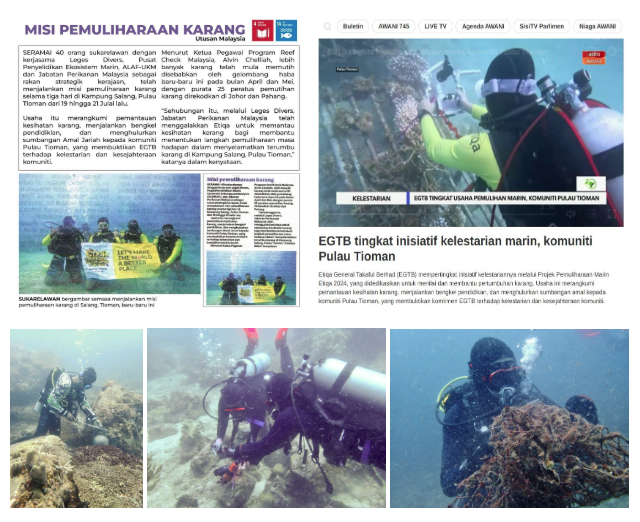
3. Free: Etika’s Marine Conservation Project returns to Pulau Tioman to propagate new corals.
A total of 40 volunteers in collaboration with Leges Divers, Marine Ecosystem Research Center (EKOMAR) ALAF-UKM and the Malaysian Fisheries Department, carried out a three-day coral conservation mission in Kampung Salang, Pulau Tioman from 19 to 21 July 2024. The effort included monitoring coral health, conducting educational workshops, and extending Amal Jariah donations to the Pulau Tioman community. This initiative focuses on coral reef restoration as a proactive measure to protect and rehabilitate vital marine ecosystems. Through coral transplantation activities, the program provides a practical solution to mitigate the impacts of global warming and climate change on fragile reef habitats. Beyond restoration efforts, the mission also serves as an awareness platform, educating participants and the wider community on the importance of coral reef conservation, marine biodiversity, and collective responsibility in preserving ocean health for future generations.
Source: https://www.facebook.com/share/p/1WyehMfxyL/ ,
Source: www.astroawani.com/videos/
4.Free: Beach Cleaning Program at Pulau Pasir Panjang Beach Langkawi Research Center (PPL)-UUM
The Pasir Panjang Island Beach Cleaning Program was held on 19 September 2024. Involving 35 students and staff of Langkawi Research Center (PPL) UKM and students from Inasis Bank Muamalat, Universiti Utara Malaysia (UUM). Apart from beach cleaning, activities also involve exploration to various sites including the Kilim Geopark, Eagle Watching, Fish Cage and Kilim Pinnacle before. This program exposed participants with the natural resources and biodiversity of Langkawi Island, and the importance of their conservation for future generations. The program had improved the quality of nearby marine coastal waters. Removal of marine litter and debris washed ashore prevents them from reentering the sea and polluting the environment.
Source:www.facebook.com/

5. Paid: Edutourism Activities at UKM Langkawi Research Centre (PPL)
UKM offers educational tour packages through its Langkawi Research Center (PPL) that focus on sustainable fisheries and tourism. These packages are designed to engage communities in sustainable practices related to fisheries, aquaculture, and tourism, offering hands-on experiences that highlight ecosystem conservation and traditional livelihoods. UKM’s dedication to sustainable water and land management for tourism, equipping participants with the knowledge to promote tourism that enhances environmental stewardship, safeguards biodiversity, and fosters a balanced relationship between tourism and conservation. This program is accessible to the local community on an affordable, paid basis, with special discounted rates for students, ensuring that sustainable tourism education is widely available and inclusive.
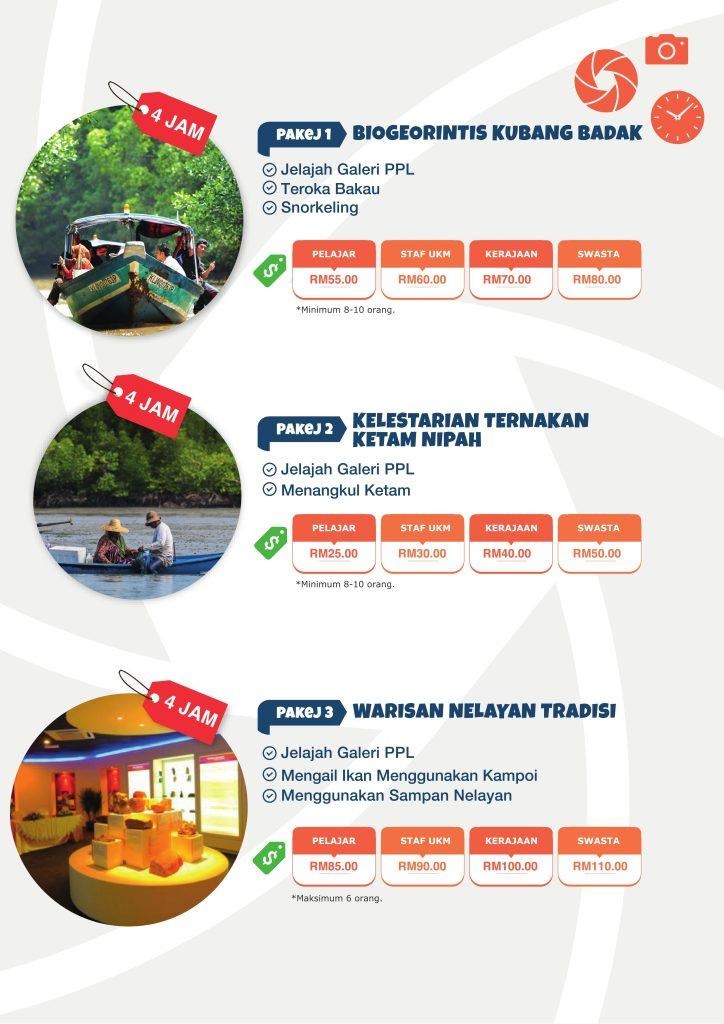
Edutourism outlines three educational tour packages offered by UKM Langkawi Research Center (PPL)
Package 1: Biogeorintis Kubang Badak
- Activities: Explore PPL Gallery, Mangrove Exploration, and Snorkeling.
- Prices: Ranges from RM55 (students) to RM80 (private individuals).
- Group Requirement: Minimum of 8-10 participants.
Package 2: Nipah Crab Livestock Sustainability
- Activities: Visit PPL Gallery and Crab Catching.
- Prices: Ranges from RM25 (students) to RM50 (private individuals).
- Group Requirement: Minimum of 8-10 participants.
Package 3: Traditional Fisherman’s Heritage
- Activities: Tour PPL Gallery, Traditional Fishing with Kampoi, and Boat Usage.
- Prices: Ranges from RM85 (students) to RM110 (private individuals).
- Group Requirement: Maximum of 6 participants.

UKM also provides two additional educational tour packages offered by UKM Langkawi Research Center (PPL) such as
Package 4: Mangrove Ecosystem Heritage
- Activities: Explore PPL Gallery, Mangrove Exploration, Snorkeling, and Crab Catching.
- Prices: Ranges from RM70 (students) to RM120 (private individuals).
- Group Requirement: Minimum of 8-10 participants.
Package 5: Natural Heritage and Tradition
- Activities: Tour PPL Gallery, Crab Catching, Traditional Fishing with Kampoi, and Boat Usage.
- Prices: Ranges from RM110 (students) to RM160 (private individuals).
- Group Requirement: Minimum of 6 participants.
Both packages aim to provide immersive experiences in mangrove ecosystems and traditional fishing practices, supporting sustainable tourism and environmental education with guidance from experienced tour guides.
Through its diverse educational offerings and community outreach initiatives, UKM demonstrates leadership in advancing sustainable fisheries, aquaculture and tourism management. The university’s programs combine scientific expertise with community participation, cultivating environmental stewardship and enhancing local capacity for marine and freshwater resource conservation. From coral propagation in Tioman Island to edutourism-based mangrove exploration in Langkawi, each initiative reflects UKM’s commitment to preserving aquatic ecosystems while supporting socio-economic development. By bridging research, education, and real-world application, UKM not only contributes to the UKM Sustainability Strategic Plan 2030 but also reinforces its role in achieving the United Nations Sustainable Development Goals, particularly SDG 14 (Life Below Water). These collective efforts position UKM as a model for sustainable fisheries education and community engagement in Malaysia and the wider Asia-Pacific region.