


Protect, restore and promote sustainable use of terrestrial ecosystems, sustainably manage forests, combat desertification, and halt and reverse land degradation and halt biodiversity loss
SDG 15 Indicator
15.2 – Supporting land ecosystems through education
15.2.3 – Maintain and extend current ecosystems’ biodiversity
UKM’s commitment to conservation and maintaining current ecosystems’ biodiversity extends to safeguarding diverse plant, animal and genetic resources through dedicated long-term conservation facilities. As human activity continues to disrupt ecosystems with habitat loss, pollution, climate change, and overexploitation, UKM recognizes the critical need for robust conservation efforts. UKM’s conservation programs aim to preserve natural habitats that support the behavior and well-being of both flora and fauna. The university maintains a permanent reserve forest, botanic garden and designated living labs, which serve as the cornerstone of its comprehensive conservation strategy. Through these initiatives, UKM is actively fostering biodiversity and protecting essential genetic resources for future generations.
List of main Conservation Area in UKM
| No | Conservation Area |
| 1 | UKM Permanent Reserve Forests |
| 2 | Botanic Gardens |
| Plant House Complex | |
| Fern Garden | |
| Herb Garden | |
| 3 | UKM Living Lab |
| Marine Research Centre (EKOMAR) UKM | |
| Chini Lake Research Center (PPTC) UKM |
1. Permanent Forests as Conservation Centers
The UKM Permanent Forests play a crucial role as conservation centers dedicated to the preservation of Malaysia’s rich natural heritage. The UKM Permanent Reserve Forests was part of what used to be known as the Langat Basin Forest area (Figure 1.22.1). Since the early days of its development, the planners of UKM have envisaged a holistic concept of having the campus resemble a botanic garden as a whole to serve as living laboratories for the use of UKM students in education, research and as long-term conservation facilities. As a result, UKM has set an example and currently holds one of the best germplasm collections of ornamental plants, especially palm and ferns collections in Malaysia. The UKM Permanent Forest Reserve is an important carbon sink green area in the Langat Basin as well as a biological laboratory and open classroom for UKM students.
These forest reserves provide a safe haven for a wide range of wildlife species, including mammals, birds, reptiles, amphibians, and invertebrates, many of which are rare or threatened. The presence of these animals is a testament to the ecological integrity of the area, where natural food chains and breeding cycles are able to thrive without major disturbances.
As conservation centers, the UKM Permanent Forests are more than just reservoirs of flora and fauna; they are living laboratories for scientific research, environmental education, and sustainable management practices. By maintaining the balance between conservation and human engagement, these forests contribute to the long-term preservation of biodiversity while supporting UKM’s commitment to environmental stewardship and sustainable development.
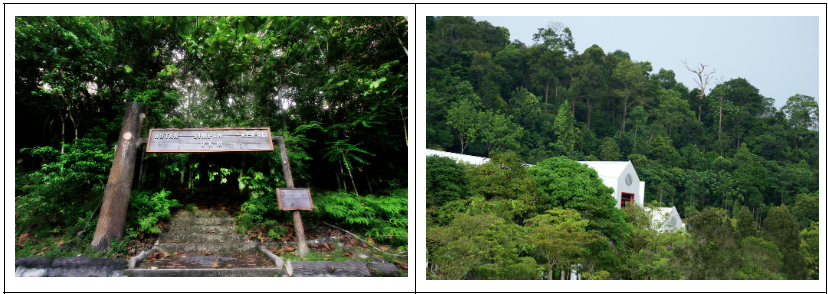
Among the origin species found in it are Shorea leprosula (Merbau), Irvingia malayana (Pauh Kijang), Ochanostachys amentacea (Petaling), Streblus elongatus (Tempinis), Dialium indum (Keranji), and Fagraea fragrans (Tembusu). This shows that the Bangi Forest Reserve is a suitable habitat to support the species endemic flora and fauna in Peninsular Malaysia. Some of the species available in UKM Permanent Reserve Forest.


The UKM Bangi Campus is home to a diverse range of wildlife species, including langurs and long-tailed macaques shown in Table below, which have coexisted with the campus community since its establishment. These species contribute to the campus’s rich biodiversity and emphasize the importance of sustainable practices in preserving natural habitats within the university grounds.
For the fauna category, several types of birds, insects and primates among the unique fauna recorded here. Some species of plants and insects found in this forest have been listed in the Red List of Malaysian Plants (IUCN) can also be found. Two wild species such as langurs and long-tailed macaques that have inhabited the campus since its establishment and had been conserved by UKM.
List of fauna conserved species in Permanent Reserve Forest UKM
| No | Organisms | Photo | |
| Type | Species | ||
| 1 | Langur | Trachypithecus obscurus | |
| 2 | Long-tailed macaque | Macaca fascirularis | |
In 2018, Universiti Kebangsaan Malaysia (UKM) published a book titled A Natural Heritage: The Flora and Fauna of Universiti Kebangsaan Malaysia, edited by Haja Maideen Kader Maideen, Wan Juliana Wan Ahmad, and Mohamad Ruzi Abdul Rahman. This publication serves as a comprehensive documentation of the biological diversity found within UKM’s Permanent Forest Reserve, showcasing the university’s rich natural heritage.
The book explores the variety of flora and fauna that thrive in the reserve, emphasizing the importance of biodiversity conservation and ecosystem sustainability within the campus environment. It reflects UKM’s ongoing commitment to integrating research, education, and conservation, ensuring that the natural ecosystems surrounding the university continue to serve as living laboratories for scientific discovery and environmental stewardship in line with SDG 15: Life on Land. Figure below show the book on A Natural Heritage: The Flora and Fauna of Universiti Kebangsaan Malaysia.

This study identifies tree species with the highest number of individuals across three diameter classes—1 cm, 5 cm, and 10 cm within a 0.12 ha plot. The analysis provides insights into species dominance and population structure, contributing to the understanding of forest composition and regeneration dynamics in the study area. Detailed numbers of the species can be found in table below.
List of the species with higher number of total individual for tree with diameter of 1cm, 5cm, and 10cm in 0.12 ha plot.
| Species Group | Species | Family | n |
| Shrub | Leptaspis tetraphylla (Vahl) Radtk. | Sapindaceae | 9 |
| Urophyllum griffithianum (Wight) Hook.f. | Rubiaceae | 6 | |
| Rothmannia macrophylla (R.Br. ex Hook.f.) Bremek. | Rubiaceae | 5 | |
| Ixora grandifolia Zoll. & Moritzi | Rubiaceae | 3 | |
| Phaeanthus ophthalmicus (Roxb. ex G. Don) J. Sinclair | Annonaceae | 3 | |
| Treelet | Baccaurea parviflora (Mull.Arg.) Mull.Arg. | Euphorbiaceae | 9 |
| Glycosmis macrophylla (Blume) Miq. | Rutaceae | 6 | |
| Ardisia colorata Roxb. | Myrsinaceae | 6 | |
| Goniothalamus ridleyi King | Annonaceae | 4 | |
| Knema furfuracea (Hook.f. & Thomson) Warb. | Myristicaceae | 3 | |
| Understorey | Aidia densiflora (Wall.) Masam. | Rubiaceae | 40 |
| Aporusa microstachya (Tul.) Müll.Arg. | Euphorbiaceae | 29 | |
| Gymnocranthera canarica (King) Warb. | Myristicaceae | 19 | |
| Diospyros apiculata Benn. | Ebenaceae | 15 | |
| Diospyros sumatrana Miq. | Ebenaceae | 12 | |
| Main Canopy | Sandoricum koetjape (Burm.f.) Merr. | Meliaceae | 13 |
| Gymnacranthera forrestii (King) Warb. | Myristicaceae | 9 | |
| Gymnacranthera farquhariana (Hook.f. & Thomson) Warb. | Myristicaceae | 7 | |
| Dacryodes rostrata (Blume) H.J. Lam | Burseraceae | 7 | |
| Santiria laevigata Blume | Burseraceae | 6 | |
| Emergent | Dacryodes costata (Benn.) H.J. Lam | Burseraceae | 9 |
| Koompassia malaccensis Maing. ex Benth. | Leguminosae | 8 | |
| Shorea acuminata Dyer | Dipterocarpaceae | 3 | |
| Shorea leprosula Miq. | Dipterocarpaceae | 3 | |
| Sindora echinocalyx (Benth.) Prain | Leguminosae | 3 |
In November 2023, a research project titled “Tree Community Structure and Diversity in Bangi Forest Reserve, The National University of Malaysia (UKM), Bangi, Selangor” was conducted by Nurin Adriany, a student from the Faculty of Science and Technology. The study aimed to prepare voucher specimens for the identification of trees up to the lowest taxonomic level, species.
The research, conducted on a 0.009-hectare plot within the Bangi Forest Reserve, successfully recorded 142 individual trees with diameters ranging from 0.1 cm to 5 cm and above at breast height (DBH). All individuals were identified to the species level, revealing a total composition of 27 families, 45 genera, and 142 species.
This study not only provides essential data for species identification and voucher specimen preparation but also underscores the importance of conserving native flora within the Bangi Forest Reserve, a vital green lung within the UKM campus. The findings contribute to biodiversity monitoring, ecological education, and sustainable forest management, supporting SDG 15 (Life on Land) and reinforcing UKM’s commitment to environmental stewardship and ecosystem conservation. Table below shows the list of the families, number of genus and species that are available in reserve forest UKM. Full document of the research paper can be excess by the link : drive.google.com/file/
List of the families, number of genus and species that are available in reserve forest UKM.
| No | Famili | Numbers of Genus | Numbers of Species | Numbers of Individu |
| 1 | Anacardiaceae | 1 | 2 | 3 |
| 2 | Annonaceae | 2 | 3 | 25 |
| 3 | Apocynaceae | 1 | 1 | 1 |
| 4 | Araucariaceae | 1 | 1 | 1 |
| 5 | Arecaceae | 1 | 1 | 5 |
| 6 | Aristolochiaceae | 1 | 1 | 1 |
| 7 | Burseraceae | 1 | 1 | 6 |
| 8 | Cannabaceae | 1 | 1 | 1 |
| 9 | Clusiaceae | 1 | 2 | 2 |
| 10 | Ebenaceae | 1 | 1 | 5 |
| 11 | Euphorbiaceae | 1 | 1 | 1 |
| 12 | Fabaceae | 1 | 2 | 3 |
| 13 | Ixonanthoceae | 1 | 2 | 4 |
| 14 | Lauraceae | 3 | 3 | 6 |
| 15 | Malvaceae | 2 | 2 | 7 |
| 16 | Melastomataceae | 4 | 4 | 9 |
| 17 | Moraceae | 1 | 3 | 3 |
| 18 | Myristicaceae | 1 | 2 | 10 |
| 19 | Myrtaceae | 2 | 4 | 4 |
| 20 | Phyllanthaceae | 3 | 3 | 4 |
| 21 | Rhizophoraceae | 1 | 1 | 5 |
| 22 | Rosaceae | 1 | 1 | 1 |
| 23 | Rubiaceae | 7 | 8 | 23 |
| 24 | Rutaceae | 2 | 2 | 3 |
| 25 | Sapindaceae | 2 | 2 | 4 |
| 26 | Sapotaceae | 1 | 4 | 4 |
| 27 | Thymelaeaceae | 1 | 1 | 7 |
| Total | 45 | 55 | 142 |
In 2022, a research article titled “Identifying the Diversity of Freshwater Aquatic Species in Tasik Ghazali, UKM Using Taxonomy Analysis” underscored the critical importance of biodiversity conservation within the Universiti Kebangsaan Malaysia (UKM) campus ecosystem. Conducted through five sampling activities using both active and passive fishing methods, the study successfully collected 1,268 samples of freshwater aquatic life, identifying eight distinct species. The findings highlight Puntius sp. as the most abundant species and Clarias batrachus as the least common, reflecting variations in species distribution and habitat adaptation.Detail of the article can be found drive.google.com/file/
This study not only contributes to the scientific understanding of aquatic fauna diversity but also supports the conservation of genetic resources vital for food security, ecosystem balance, and sustainable biodiversity management and continues with the conservation of the species that are available. By documenting and preserving the genetic and ecological data of native aquatic species, UKM reinforces its role in long-term biodiversity conservation, aligned with SDG 14 (Life Below Water) and SDG 15 (Life on Land). The result of the sampling can be found in Table below.
Cumulative Total of Aquatic Life in Tasik Ghazali, UKM
| No. | Species | Number of individual |
| 1 | Puntius sp. | 464 |
| 2 | Poecilia reticulata | 328 |
| 3 | Macrobrachium lanchesteri | 231 |
| 4 | Gambusia affinis | 143 |
| 5 | Macrobrachium malayanum | 63 |
| 6 | Betta pugnax | 25 |
| 7 | Clarias batrachus | 7 |
| 8 | Gyraulus sp. | 7 |
| Jumlah Keseluruhan | — | 1,268 |
Aquatic Life Catches by Sampling Activity in Tasik Ghazali, UKM
| Sampling Activity | Number of individual | Observation |
| 1 | 413 | The highest total with various species identified |
| 2 | 133 | A significant decrease from the first activity |
| 3 | 329 | An increase again in the total catch |
| 4 | 228 | A moderate decrease |
| 5 | 165 | The lowest total among the five activities |
| Total Amount | 1,268 | Consistent with the overall number of species |
2. Botanic Gardens including the UKM Nature education and conservation
As an institute that supports environmental sustainability, UKM puts in ecosystem conservation efforts in the effort to establish Botanic Gardens as UKM Nature Education Forest. The establishment of the Botanical Garden is to become a center for the conservation and preservation of selected plant groups and the biological diversity of flora and fauna within the UKM Botanical Garden. Botanic Garden consists of several 4 units which are the Plant House Complex, the UKM Fern Garden, the UKM Herb Park and the Permanent Bangi Forest Reserve, UKM.
This garden was established for:
- Preservation and conservation of plant species that are threatened with extinction
- Supporting research activities and acting as a natural laboratory for research
- The transfer of knowledge about the biological diversity of our country and also about the environment to UKM citizens and non-citizens
- Reference center for flora diversity in Malaysia
- Become a recreational park for citizens and also UKM citizens
- Plant genetic bank center that is in its environment


The UKM Botanical Garden, managed by the Faculty of Science and Technology, serves as a valuable platform for all members of the UKM community to actively participate in the conservation and preservation of the garden’s rich biodiversity, encompassing both flora and fauna.
In addition, UKM plays a crucial role in contributing to the Malaysia Biodiversity Information System (MyBIS), a central repository and database that facilitates access to comprehensive information on biodiversity studies and management across Malaysia. This initiative reinforces UKM’s commitment to supporting national efforts in biodiversity conservation.

Link: www.mybis.gov.my/one/specimen.php?menu=70
Botanic garden conservation involves the preservation and protection of plant species from extinction, particularly those that are threatened or endangered. These gardens play a crucial role in biodiversity conservation through several key activities: More than 300 species of herbs,fern and plantae are conserved in Botanic Garden UKM. In Table below, we have listed several of the conserved species that currently inhabit Taman Botani UKM.
List of conserved species in Botani Garden UKM
No | Species Name | Photo | |
| 1 | Intsia palembanica | ||
| 2 | Dipterocarpus kerrii | ||
| 3 | Neobalanocarpus heimii | ||
| 4 | Miconia crenata | ||
3. UKM Living Lab as a Nature education and conservation Center
UKM has conducted continuous campus programs for conservation of plant (flora), animal (fauna) and genetic resources for food and agriculture secured in either medium or long-term conservation facilities. In UKM, we have established four living labs (Langkawi Research Center, Chini Lake Research Center, Fraser Hill Research Center and Marine Ecosystem Research Center) for conservation. Marine Ecosystem Research Center and Chini Lake Research Center are more focused on conservation programs.
Till 2023, we had successfully planned and implemented programs to conserve biodiversity including flora and fauna in the long term conservation time frame. The conservation in Marine Ecosystem Research Center is more to coral and fish conservation and Chini Lake Research Center more to flora includes lotus flower. Besides, the living lab has been used as the research setting in research and activities related to conservation. UKM’s efforts in conservation works are as stated in Table below.
Conservation works in UKM living labs
| Bil | Organisms | Photo | Program | |
| Type | Species | |||
| 1 | Coral | Acropora muricata | Coral Conservation Project 2024 Location : Tioman Island, Pahang https://www.facebook.com/alafukm/posts/pfbid02UStwmsQNXqncBJSYANwiTrkddtqCny3x7iUD84aicbHpsGTt3EbVu1zEhU7TXDhjl?rdid=YrGTk9i5V8FpUXhX# A total of 40 volunteers, in collaboration with Leges Divers, EKOMAR ALAF-UKM, and the Department of Fisheries Malaysia as a strategic government partner, carried out a three-day coral conservation mission in Kampung Salang, Tioman Island, from 19 to 21 July. The effort included coral health monitoring, conducting educational workshops, and contributing through a charitable donation (Amal Jariah) to the Tioman Island community, demonstrating EGTB’s commitment to sustainability and community well-being.pagate new corals in Kampung Salang. | |
| 2 | Acropora cytherea | |||
| 3 | Pocillopora acuta | |||
| 4 | Porites cylindrica | |||
| 5 | Coral Cleaning | Coral Monitoring and Care by Marine Research Centre (EKOMAR) Marine Research Centre (EKOMAR), UKM is continuously monitoring and cleaning the coral in order to conserve the coral species. The activity of cleaning skeletons from Black Sponges Terpios hoshinota which causes the coral to die. The Black Sponges are lifted from the artificial skeleton to be dumped on land. Nubbins replanted in an artificial framework (coral restoration). | ||
| 6 | Lotus flower | Nelumbo nucifera | Sustainable Lotus Conservation in Chini Lake for Continuity of Biosphere Heritage Location : Chini Lake, Pahang DescriptionThis conservation program is supported by ECERDC to FRIM with collaboration of Chini Lake Research Center (PPTC) UKM in building 9 nursery ponds and 50 units of flotilla (floating lotus) in Chini Lake, as efforts to restore the lotus population hence preserving the iconic lotus in Chini Lake. aktiviti ini masih aktif dijalan kan pada tahun 2024https://www.ukm.my/pptc/news/majlis-penyerahan-projek-konservasi-teratai-secara-lestari-di-tasik-chini-bagi-kesinambungan-rizab-biosfera/ | |
| 7 | Pitcher plant (Periuk kera) | Nepenthes | The conservation of Periuk Kera (pitcher plant, Nepenthes) at Fraser’s Hill is a vital ecological initiative aimed at preserving the biodiversity of this unique highland area. Fraser’s Hill, located in the state of Pahang, Malaysia, is well-known for its rich biodiversity, cool climate, and being a haven for rare flora and fauna, including various species of Nepenthes. The conservation of Periuk Kera in this region is essential due to the plant’s vulnerability to habitat destruction, climate change, and human activities. Exploration on introducing this species to the community is often carried out to give exposure to endangered species.https://www.facebook.com/story.php?story_fbid=6165005700198348&id=100000669369309&rdid=hQcBC625g8oAQXYJ | |
UKM Release of Fish Seeds at Tasik Chini UNESCO Biosphere Reserve Site
From the year 2022, UKM undertook a significant ecological initiative by releasing 21,000 Lampan Sungai Baung fish into the UNESCO Biosphere Reserve at Tasik Chini. This restocking project, aimed at enhancing conservation of aquatic ecosystems. By reintroducing native fish species, UKM not only bolsters food availability for local communities that rely on these resources but also aids in maintaining the ecological balance and biodiversity of Tasik Chini. The initiative is part of UKM’s broader commitment to fostering sustainable practices that ensure the resilience of aquatic ecosystems and contribute to Malaysia’s long-term goals in biodiversity conservation and food security. Table below is the inventory of the fish species that have been conserved in Tasik Chini.
Fish species list and density rank in Tasik Chini
Species | Local Name | Individual | Mean Physical | |
| Standardlength (cm) | Weight(g) | |||
| Family Notopteridae | ||||
| Notopterus notopterus | Potok/Selat | 213 | 17.1 | 37.2 |
| Family Cyprinidae | ||||
| Thynnichthys thynnoides | Loma | 112 | 18.3 | 65.9 |
| Labiobarbus fasciata | Mengkawan | 18 | 18.8 | 60.7 |
| Family Siluridae | ||||
| Kryptopterus bicirrhis | Lais | 12 | 22.9 | 53.9 |
| Family Helostomatidae | ||||
| Helostoma temminckii | Tembakang | 10 | 15.3 | 95.1 |
| Family Cyprinidae | ||||
| Cyclocheilichthys apogon | Cemperas | 8 | 13.7 | 30.7 |
| Labiobarbus festiva | Mengkawan | 8 | 18.9 | 79.0 |
| Family Bagridae | ||||
| Mystus singaringan | Kenjing | 7 | 15.1 | 92.3 |
| Family Cyprinidae | ||||
| Osteochilus vitattus | Terbul | 9 | 15.5 | 47.2 |
| Family Pristolepididae | ||||
| Pristolepis fasciata | Patong | 5 | 10.7 | 58.9 |
| Family Cyprinidae | ||||
| Osteochilus melanopleura | Terbul jalur | 6 | 18.7 | 56.3 |
| Family Butidae | ||||
| Oxyeleotris marmoratus | Ketutu | 5 | 27.8 | 254.9 |
| Family Cyprinidae | ||||
| Puntiuplites bulu | Tengalan | 3 | 17.0 | 54.6 |
| Family Pristolepididae | ||||
| Pristolepis grooti | Kepor | 2 | 11.6 | 31.7 |
| Family Cyprinidae | ||||
| Barbichthys laevis | Petulu | 2 | 19.0 | 62.3 |
| Macrochirichthysmacrochirus | Parang Sungai | 2 | 26.4 | 85.6 |
| Family Clariidae | ||||
| Clarias batrachus | Keli | 2 | 21.7 | 94.5 |
| Family Pangasiidae | ||||
| Pangasius spp. | Patin | 1 | 45.5 | 580.0 |
| Family Cyprinidae | ||||
| Amblyrhynchichthystruncatus | Puling | 1 | 16.6 | 51.2 |
| Hampala macrolepidota | Sebarau | 1 | 26.8 | 223.1 |
| Labiobarbus leptocheilus | Mengkawan | 1 | ||
| Barbonymus schwanefeldii | Lampam Sungai | 1 | ||
| Cyclocheilichthys armatus | Mata Merah | 1 | ||
| Family Bagridae | ||||
| Hemibagrus capitulum | Baung lemak | 1 | 19.5 | 60.1 |
| Family Channidae | ||||
| Channa lucius | Bujuk | 1 | 34.2 | 480.6 |
| Family Anabantidae | ||||
| Anabas testudineus | Puyu | 1 | 12.0 | 85 |
| Family Butidae | |||||
| Oxyeleotris marmoratus | Ketutu | 5 | 27.8 | 254.9 | 2.88 |
| Family Cyprinidae | |||||
| Puntiuplites bulu | Tengalan | 3 | 17.0 | 54.6 | 2.70 |
| Family Pristolepididae | |||||
| Pristolepis grooti | Kepor | 2 | 11.6 | 31.7 | |
| Family Cyprinidae | |||||
| Barbichthys laevis | Petulu | 2 | 19.0 | 62.3 | 1.37 |
| Macrochirichthysmacrochirus | Parang Sungai | 2 | 26.4 | 85.6 | 3.27 |
| Family Clariidae | |||||
| Clarias batrachus | Keli | 2 | 21.7 | 94.5 | 4.03 |
| Family Pangasiidae | |||||
| Pangasius spp. | Patin | 1 | 45.5 | 580.0 | |
| Family Cyprinidae | |||||
| Amblyrhynchichthystruncatus | Puling | 1 | 16.6 | 51.2 | |
| Hampala macrolepidota | Sebarau | 1 | 26.8 | 223.1 | |
| Labiobarbus leptocheilus | Mengkawan | 1 | |||
| Barbonymus schwanefeldii | Lampam Sungai | 1 | |||
| Cyclocheilichthys armatus | Mata Merah | 1 | |||
| Family Bagridae | |||||
| Hemibagrus capitulum | Baung lemak | 1 | 19.5 | 60.1 | |
| Family Channidae | |||||
| Channa lucius | Bujuk | 1 | 34.2 | 480.6 | |
| Family Anabantidae | |||||
| Anabas testudineus | Puyu | 1 | 12.0 | 85 | |
Lotus Flotilla Program in Collaboration with Tasik Chini Research Centre (PPTC), ALAF-UKM, FRIM and ECERDC to Prevent the Extinction of Lotuses in Tasik Chini
The Lotus Flotilla Program is a sustainable lotus plant conservation initiative launched in the Tasik Chini Biosphere Reserve in July 2020 and remains actively ongoing as long-term conservation facilities . The project is led and managed by the Tasik Chini Research Centre (PPTC) in collaboration with the East Coast Economic Regional Development Council (ECERDC), the Forest Research Institute Malaysia (FRIM), ALAF-UKM, and the Orang Asli community of Tasik Chini.
Funded by ECERDC and implemented by FRIM together with PPTC and ALAF-UKM, the project involves the construction of nine nursery ponds and 50 units of floating lotus (flotilla) in Tasik Chini shown in Figure: . This initiative aims to restore the declining lotus population and preserve the lotus as an iconic symbol of Tasik Chini. In addition, it focuses on researching and implementing innovative conservation measures to ensure the long-term survival of the lotus plants and the health of their ecosystem for future generations.
The program centers on replanting lotus using specially designed floating flotillas that serve as nurseries in the lake, followed by the natural replanting of lotus plants in targeted areas. Beyond conservation activities, it also provides training sessions and workshops on lotus planting techniques for the local community and relevant stakeholders, thereby strengthening community participation and ensuring the sustainability of the initiative.
More information can be found at:
- www.ukm.my/pptc/news/majlis-penyerahan-projek-konservasi-teratai-secara-lestari-di-tasik-chini-bagi-kesinambungan-rizab-biosfera/
- www.ukm.my/pptc/news/lotus-nursery-project-joint-inspection-training-for-handover/

UKM cares about the importances of biodiversity and nature in UKM as we involve the plans and initiatives for preservation and conservation of land and marine ecosystems in our Sustainability Strategic Plan 2030 which can be accessed on page 50 and page 51.

