

Promote peaceful and inclusive societies for sustainable development, provide access to justice for all and build effective, accountable and inclusive institutions at all levels
SDG 16 Indicator
16.3 – Working with government
16.3.2 – Policy- and lawmakers outreach and education
Universiti Kebangsaan Malaysia (UKM) demonstrates its strong commitment to policy outreach, general education, and capacity-building for policymakers and law enforcers through strategic academic programmes, workshops and professional certifications. These initiatives reflect UKM’s role as a national hub for governance training and institutional strengthening, equipping leaders with the knowledge, skills and ethical foundation to make informed decisions in governance, law enforcement and public administration. Through partnerships with key government agencies, including the Royal Malaysia Police (PDRM), Malaysian Anti-Corruption Commission (MACC), and Narcotics Criminal Investigation Department (NCID), UKM provides targeted education and leadership development in critical areas such as corruption prevention, forensic science, ethics, law and strategic governance. These efforts align with Sustainable Development Goal 16 (Peace, Justice and Strong Institutions), reinforcing UKM’s mission to promote transparency, justice and accountable leadership across Malaysia’s public institutions.
1. Professional Certificate in Royal Malaysia Police Leadership Programme
UKM actively contributes to policy and lawmakers’ outreach, education and capacity-building through structured training and professional development programmes that strengthen national governance and institutional leadership. In collaboration with the Royal Malaysia Police (PDRM), UKM through the Centre for Professional and Leadership Development (Professional UKM), successfully organized a series of Professional Certificates in Royal Malaysia Police Leadership Programmes in 2024, designed specifically for law enforcement policymakers and senior officers.
These programmes, which included the Professional Certificate in Senior Police Leadership Competency Assessment, Operational Police Leadership and Strategic Police Leadership, engaged a total of 70 PDRM participants, including top management officers. Conducted between 9–20 December 2024, the courses focused on enhancing strategic decision-making, ethical governance, crisis management and operational excellence. Participants were equipped with the latest leadership frameworks and practical tools to address evolving challenges in national security, law enforcement, and public policy.
Through initiatives like these, UKM reinforces its national role as a knowledge and training hub for policymakers and law enforcers, promoting good governance, transparency and institutional resilience in full alignment with SDG 16 (Peace, Justice, and Strong Institutions) and Malaysia’s agenda for ethical and professional public service.

Link: www.ukm.my/profesional-ukm/news/sijil-profesional-program-kepimpinan-polis-diraja-malaysia
2. CSI Standard Operating Procedure (SOP) Workshop on Psychoactive Substances
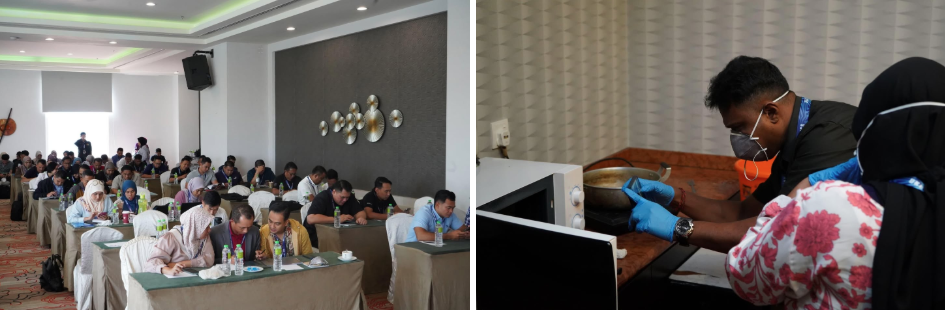
UKM demonstrates its strong commitment to policy and lawmakers’ outreach, general education and capacity-building by organizing targeted training and professional development programmes that strengthen national institutions and governance capacities. One notable initiative is the CSI Standard Operating Procedure (SOP) Workshop on Psychoactive Substances, conducted by the Forensic Science Programme, Faculty of Health Sciences, UKM, on 23–24 September 2024 at Bangi Resort Hotel.
This specialized workshop brought together 150 investigating officers from the Narcotics Criminal Investigation Department (NCID), focusing on enhancing their competencies in crime scene investigation (CSI) procedures, forensic documentation and evidence sampling protocols for the analysis of New Psychoactive Substances (NPS). Delivered through a combination of lectures, simulations, and hands-on practical sessions, the workshop provided an evidence-based platform for participants to strengthen their understanding of forensic technologies and investigative standards aligned with international best practices.
By facilitating knowledge transfer between academia and law enforcement agencies, UKM directly contributes to the upskilling of policymakers and law enforcers in the fields of law, forensic science, and technology. This initiative exemplifies UKM’s role as a national hub for professional education and policy support, advancing the goals of SDG 16 (Peace, Justice, and Strong Institutions) through capacity-building, innovation, and science-driven policy engagement.
3. Master of Social Science (Corruption Studies) Program UKM-SPRM
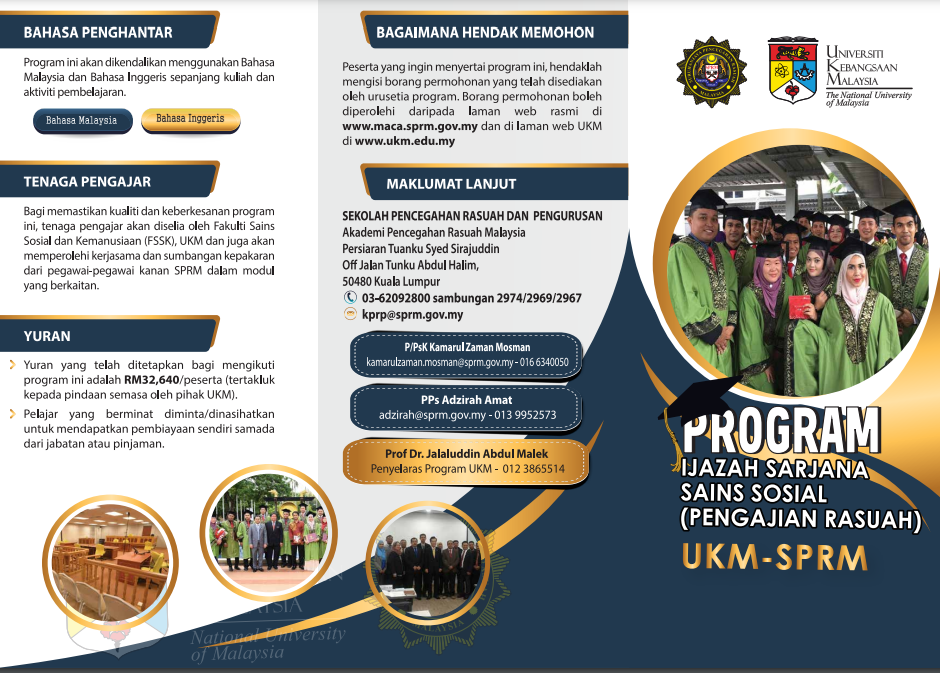
UKM collaborates with the Malaysian Anti-Corruption Academy, Malaysian Anti-Corruption Commission (MACC), to offer the Master of Social Science (Corruption Studies) Program.
Course Objectives
This program aims to provide value-added knowledge and advanced academic training to MACC officers and enforcement agency officers, both local and international, to enhance their professionalism.
The program produces graduates who are attuned to the latest developments in design, approaches, and technologies in corruption activities and management at the international level.
The program enhances the capabilities of MACC officers and related agency officers by equipping them with up-to-date career knowledge, heightened awareness of current developments, and a broad and deep perspective, preparing them as future leaders in the MACC and high-level enforcement agencies.
The main course modules include:
- Sociology of Corruption
- Criminology
- Law and Corruption Crimes
- Advanced Research Methods
- Corruption Investigation and Management
- Ethics, Governance, and Corruption
- Corruption Crimes and Social Control
- International Benchmarking Project
- Master’s Thesis in Corruption Studies
For further information can visit this link: https://gmaca.sprm.gov.my/ms/program_sarjana
Through its collaborative training and educational initiatives such as the Professional Certificate in Royal Malaysia Police Leadership Programme, the CSI Standard Operating Procedure (SOP) Workshop on Psychoactive Substances and the Master of Social Science (Corruption Studies) offered with MACC-UKM continues to play a pivotal role in bridging academia and policymaking. These programmes not only strengthen the capacity of policymakers and enforcement officers but also foster evidence-based decision-making, ethical governance and institutional resilience. By empowering leaders with advanced knowledge in law, governance and technology, UKM reaffirms its position as a trusted partner in national policy development and a driving force in advancing Malaysia’s commitment to sustainable, transparent and justice-oriented governance.