


Make cities and human settlements inclusive, safe, resilient and sustainable
SDG 11 Indicator
11.2 – Support of arts and heritage
11.2.3 – Public Access to Museums
Universiti Kebangsaan Malaysia (UKM) safeguards a wealth of national and academic treasures through its 18 diverse museums and galleries. These spaces, open to the public, showcase a range of cultural, scientific and historical themes. From the Museum of Asian Art, which highlights regional artifacts, to the Geological and Biodiversity Museums, which celebrate the natural world, UKM offers a comprehensive cultural experience. The university is also dedicated to preserving the Malay language and culture, with dedicated spaces showcasing the rich history and evolution of these traditions.
Table shows museums at UKM which open to public access
| No. | Museums |
| 1. | Tuanku Chancellor Gallery |
| 2. | Academic Heritage Museum |
| 3. | Lithograph, Caricature, and Manuscript Gallery, FSSK |
| 4. | The Malay World Manuscript Research Centre (PPMAM), ATMA UKM |
| 5. | Malay Fashion Centre, FSSK |
| 6. | The Geological Museum, FST |
| 7. | Malaysian National University Zoological Museum, FST |
| 8. | Seed Bank of Universiti Kebangsaan Malaysia, FST |
| 9. | UKM Herbarium, FST |
| 10. | Center for Insect Systematics (CIS), FST |
| 11. | Faculty of Engineering and Built Environment (FKAB) Gallery |
| 12. | Tun Fatimah Hashim Gallery |
| 13. | Anatomy and Pathology Museum, Cheras Kampus |
| 14. | Parasitology and Entomology Gallery |
| 15. | Physiology Gallery |
| 16. | Langkawi Research Centre Gallery |
| 17. | Sheikh Othman Sarawak Gallery |
| 18. | Tun Ahmad Sarji Collection |
1. Tuanku Chancellor Gallery
The Tuanku Chancellor Gallery stands as a prestigious landmark on UKM’s scenic campus, embodying the university’s legacy and evolution over more than half a century. Since its inception on 18 May 1970, this gallery chronicles UKM’s journey, achievements, and milestones in the pursuit of academic excellence. Each exhibit within the gallery reflects the university’s resilience, vision, and determination to overcome challenges and transform into a renowned center of knowledge.
Visitors to the Tuanku Chancellor Gallery are immersed in a narrative of UKM’s enduring commitment to education, cultural heritage, and nation-building, providing an inspiring reflection of the university’s impact on generations past, present, and future. As a repository of UKM’s proud history, the gallery serves not only as a tribute to academic progress but also as a beacon of inspiration for students, scholars, and the broader community. Through this gallery, UKM reaffirms its role as a custodian of knowledge and a driving force in shaping Malaysia’s educational landscape.
Link: www.ukm.my/muzium/galeri-tuanku-canselor/

2. Academic Heritage Museum
The filling and layout of the Academic Heritage Museum collection are made by the institute’s memory concept for a higher education center which is a park of knowledge and information. To create a harmonious and cheerful museum atmosphere, the combination of yellow, brown and golden colors is the main choice. The collection on display at the museum includes posters, photographs, artefacts, research results, a collection of professors’ inaugural lectures, publications, medals, certificates of appreciation, awards and recognition.
Link: www.ukm.my/muzium/

3. Lithograph, Caricature, and Manuscript Gallery, FSSK
This gallery displays collections that have never been cataloged by any research institutions. Lithographs, caricatures, and manuscripts are the main exhibits and they are important for understanding a country’s history and heritage. The lithographs in the gallery are the works of colonial artists invited by the Portuguese, Dutch, English, and French colonial governments to record the historical events that occurred in the Malay world. Among the subjects of the artworks are events, Malay society and culture, and the tropical flora and fauna found on the Malay Peninsula.
Link: www.ukm.my/sphea/en/about-us/facilities/lithograph-caricature-and-manuscript-gallery/

4. The Malay World Manuscript Research Centre (PPMAM)
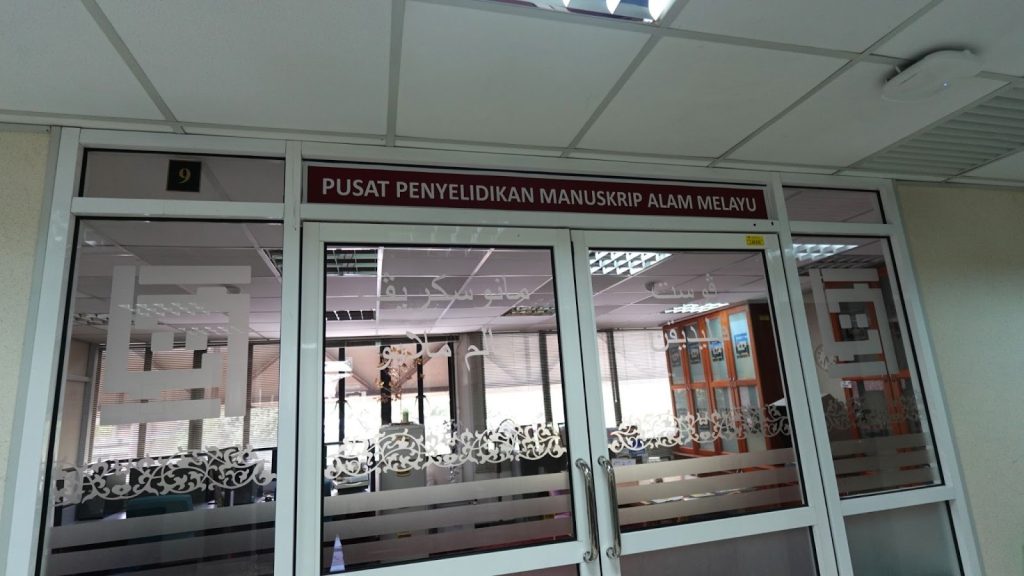
The Malay World Manuscript Research Centre (PPMAM) was established in 2010 under the Institute of the Malay World and Civilization (ATMA), Universiti Kebangsaan Malaysia (UKM). It serves as a center for advancing the study of Malay manuscripts encompassing various disciplines and fields of knowledge. PPMAM conducts research on old Malay manuscripts written in Jawi script found throughout the Malay world, as well as those concerning the Malay world discovered outside the region. It is widely known that there are approximately 10,000 to 15,000 titles of old Jawi-script manuscripts preserved across 151 libraries, archives, and museums in 28 countries worldwide. To date, only about 5% of these manuscripts have been studied, while the remaining 95% are yet to be examined and their contents remain largely unknown.

5. Malay Fashion Center, FSSK
Malay Fashion Center is a mini museum that exhibits traditional Malay fashion or clothing. This hall is used for teaching and learning sessions for students at Bitara Melayu.
Link: www.ukm.my/ppbkkm/muzium-seni-warisan/

6. The Geological Museum, FST
The Geological Museum was launched in 1990. Since the establishment of the Geological Department in conjunction with the establishment of UKM itself in 1970, efforts to develop this museum took time to complete, especially the collection of local mineral, rock and fossil samples. To date, the total number of samples collected is over 7000 samples covering the Geological Museum, Geological Gallery and Rock Archives.
Link: www.ukm.my/msa/en/repository/geology/introduction-geology/

7. Malaysian National University Zoological Museum, FST
The zoological museum has a diverse and unique collection of specimens of marine life, fish, amphibians, reptiles, birds and mammals. These specimens have been preserved since the 80s and there are also several specimens from the 70s, where these specimens are preserved using several curing methods such as curing methods in formalin and alcohol solutions of ethanol, taxidermy, bone and diaphanized.
Link: www.ukm.my/msa/en/repository/zoology/introduction-zoology/

8. Seed Bank of Universiti Kebangsaan Malaysia (UKMSB), FST
The UKM Seed Bank (UKMSB), part of the Natural History Museum at the Faculty of Science and Technology, is a vital center for the conservation and preservation of plant genetic resources. Serving as a national and regional hub, UKMSB safeguards a wide range of plant accessions, including paddy, fruits, vegetables, and more, supporting extensive research and biodiversity preservation.
UKMSB’s collection boasts over 100 traditional paddy varieties, 50 modern cultivars, and 600 biakasonic droplets, alongside 25 types of chili, 30 salad varieties, 10 nut varieties, and numerous accessions of other vegetables and fruits. These genetic resources are acquired through research, fieldwork, and seed-sharing collaborations with institutions and individuals worldwide. By maintaining such a rich diversity of plant genetics, UKMSB plays an indispensable role in promoting sustainable agriculture, protecting biodiversity, and supporting groundbreaking research in plant science. This initiative reflects UKM’s dedication to environmental stewardship, food security, and global collaboration in genetic conservation.
Link: www.ukm.my/msa/en/repository/seed-bank/introduction-seed-bank/

9. UKMalaysia Herbarium (UKMB), FST
The UKMB is located at the Faculty of Science and Technology (FST), is part of UKM’s facility center used in teaching, education and research. The UKMB Herbarium has received visits from students, lecturers and researchers from various domestic and foreign institutions.

10. Center for Insect Systematics (CIS), FST
The CIS of UKM is one of its kind in Southeast Asia. CIS is also one of the UKM’s centres of excellence. CIS was established in 1993 following the Agenda 21 of the Rio Declaration. Since its inception, the centre has a collection of over 100,000 specimens, of which >120 are type specimens. CIS has its world-circulated journal SERANGGA, which is dedicated to the publication of research findings in insect systematics and diversity, particularly in Southeast Asia as well as other parts of the world.
Link: www.ukm.my/cis/about-cis/

11. Faculty of Engineering and Built Environment (FKAB) Gallery
The FKAB Gallery is a testament to the legacy and achievements of UKM’s Faculty of Engineering and Built Environment, providing visitors with a deeper understanding of the faculty’s journey, milestones, and impact on engineering and sustainability. This gallery celebrates the faculty’s diverse activities, groundbreaking research, and contributions to society, showcasing innovations that shape the future of engineering and environmental stewardship. By highlighting key accomplishments, the FKAB Gallery inspires pride and fosters awareness of the faculty’s pivotal role in driving technological advancement and addressing global challenges. It stands as a source of motivation for current and future generations of engineers and environmental experts, embodying UKM’s commitment to excellence and societal progress.
Link: www.ukm.my/jurutera

12. Tun Fatimah Hashim Gallery
The Tun Fatimah Hashim Gallery was established at UKM to appreciate the services and contributions of a female national leader – Tun Fatimah Hashim. Tun Fatimah Hashim is the first woman appointed as a Minister in the Malaysian Cabinet. He held the portfolio of Minister of General Welfare from 20 May 1969 to the end of February 1973. Tun Fatimah Hashim has contributed a lot in an effort to fight for women’s rights in Malaysia through the UMNO Mothers’ Movement and the National Council of the Malaysian Women’s Organization (NCWO). This gallery displays Tun Fatimah Hashim’s personal collection, documentation and research materials about Tun Fatimah Hashim in an effort to preserve her treasures.
Link: www.ukm.my/women/galeri-tun-fatimah-hashim

13. Anatomy and Pathology Museum, Cheras Campus
The Anatomy Museum is located on the 3rd floor of the Preclinical Building, PPUKM. This museum was established as one of the department’s efforts to diversify teaching methods in addition to fostering self-learning. Among the collection of specimens on display is a collection of plastination and jar specimens. To facilitate learning, specimens are displayed according to the body system starting from the body system as a whole, hands, feet, respiratory system, urinary system, endocrine system, reproductive system, cardiovascular system, thorax, abdomen and others. Some of the jar specimens are also colored and labeled to make it easier for students to identify the parts involved.
Link: www.ukm.my/anatomifper/muzium-anatomi/

14. Parasitology & Entomology Gallery
The Entomology Laboratory conducts research based on entomological samples which are divided into Medical Entomology and Forensic Entomology. The laboratory is equipped with specialized equipment and chemicals for entomological research and slide preparation. Apart from that, this laboratory is also a laboratory for preparing equipment for entomology fieldwork. All materials and equipment for entomology fieldwork can be found in this laboratory.
15. Physiology Gallery
The Department of Physiology was established in 1970 with the establishment of the Faculty of Medicine, Universiti Kebangsaan Malaysia. At the beginning of its establishment, the Department of Physiology was located at Jalan Dr. Latif, Kuala Lumpur. When the permanent faculty building was completed in 1978, the Department of Physiology was located on the 4th floor, Jalan Raja Muda Abdul Aziz, Kuala Lumpur. In July 2014, the Department of Physiology was moved to the Pre-Clinical Building at Chancellor Tuanku Muhriz Hospital, UKM Medical Center, Cheras, Kuala Lumpur. The administration section is on the 18th Floor, while the laboratory & research section is on the 9th Floor.

16. Langkawi Research Center Gallery
Situated within the Langkawi UNESCO Global Geopark at the Tuanku Abdul Halim Mu’adzam Shah Campus, the Langkawi Research Center (PPL) stands as a distinguished hub for heritage conservation and geopark development. It plays a crucial role in advancing research and academic services that bridge environmental preservation with sustainable tourism. Through innovative research on geological heritage, biodiversity, and sustainable development, PPL contributes invaluable insights that support Langkawi’s status as a UNESCO Global Geopark. The gallery within the center showcases pioneering projects, conservation efforts, and partnerships that underscore UKM’s commitment to safeguarding natural heritage while promoting sustainable growth. By fostering awareness and education, the Langkawi Research Center Gallery inspires both the academic community and the public to value and protect our unique natural landscapes, reinforcing UKM’s role as a leader in environmental stewardship and sustainable development.
Link: www.ukm.my/ppl/en/

17. Sheikh Othman Sarawak Gallery
The Sheikh Othman Sarawak Gallery is situated within the Faculty of Islamic Studies, UKM. This gallery commemorates the legacy and contributions of Sheikh Othman, a prominent figure in the Sarawak Islamic community, and highlights the Islamic historical and cultural heritage of Sarawak. The gallery showcases artifacts and exhibits that provide insights into the Islamic history of the region, emphasizing Sheikh Othman’s impact on local religious and socio-cultural life.
Link: www.ukm.my/kursisos/

18. Tun Ahmad Sarji Collection
UKM Pro-Chancellor Tun Ahmad Sarji handed over his personal collection to UKM for the storage and reference of the public. That personal collection consists of letters, minutes of meetings, gifts, historic photographs, posters and CDs he received during his service with the Government and the corporate sector. Tun Ahmad Sarji said he chose to place his collections at UKM because the university is an institution that appreciates the legacy.

UKM stands as a custodian of Malaysia’s cultural, scientific, and academic heritage through its extensive network of 18 museums and galleries that are open to the public. These spaces serve as dynamic centers of learning, reflection, and community engagement bridging the university with society at large. From historical and cultural showcases such as the Tuanku Chancellor Gallery, Academic Heritage Museum, and Malay World Manuscript Research Centre (PPMAM) to scientific hubs like the Geological Museum, Zoological Museum, and Center for Insect Systematics, UKM offers the public an enriching exploration of Malaysia’s heritage, biodiversity, and academic legacy.
Through these museums, UKM not only preserves invaluable collections of artifacts, manuscripts, and specimens but also promotes inclusive education and cultural appreciation. Facilities such as the Langkawi Research Centre Gallery and Tun Fatimah Hashim Gallery emphasize environmental conservation, gender empowerment, and historical awareness reflecting UKM’s commitment to the Sustainable Development Goals (SDG 11: Sustainable Cities and Communities). Each museum embodies UKM’s vision of connecting research, heritage preservation and public engagement by offering free or open access to visitors, researchers and students from all walks of life.
Collectively, these public-access museums reinforce UKM’s role as a national leader in safeguarding Malaysia’s intellectual and cultural wealth while fostering lifelong learning and sustainability awareness. By integrating academic excellence with community outreach, UKM transforms its campuses into living classrooms where history, science and culture are accessible to all.